


 Professor Dr. Muhammad Jalal Arif

There are universities that educate generations, and there are institutions that become woven into a nation’s collective memory. Government College University Lahore belongs unmistakably to the latter category. For more than a century and a half, its historic corridors, classrooms, laboratories, lawns and literary circles have nurtured generations of men and women who went on to shape Pakistan’s intellectual, scientific, cultural, administrative, political and public life.
On 3 September 2026 at 4:00 p.m., the spirit of this extraordinary institution will once again gather under one roof when Ravians assemble for their Ravian Alumni Meet at the Bukhari Auditorium, Government College University Lahore. The occasion is far more than an alumni gathering. It is a celebration of memory, friendship and achievement, encapsulated in GCU’s celebrated motto: “Courage to Know.”
A Bridge Between Generations: Athar Ismaeel
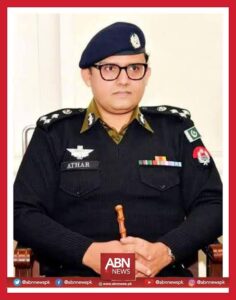 At the heart of this reunion stands Athar Ismaeel Amjad, President of the Old Ravians Union and presently serving as Regional Police Officer, Sheikhupura. His association with GCU represents precisely the kind of journey the Ravian tradition celebrates: academic formation followed by professional excellence, public responsibility and an enduring commitment to the alma mater.
Athar Ismaeel is, in many ways, a symbol of the contemporary Ravian — rooted in tradition yet engaged with the realities of modern Pakistan. His career in the police service has placed him in a demanding sphere where leadership, discipline, courage, communication and public trust are indispensable. Yet his identity as a Ravian has remained equally central. As President of the Old Ravians Union, he provides a bridge between generations, bringing together former students whose professional journeys have taken them into policing, administration, academia, literature, business, media, law, science, politics and the arts.
His present responsibility as RPO Sheikhupura adds another dimension to the Ravian success story. The police officer who commands a major regional formation is also a graduate of a university whose educational tradition has always emphasised character, intellectual independence and service to society. His command of Punjabi, Urdu and English literature, paired with his professional commitment as a police officer, illustrates the breadth of the Ravian personality: competence in the profession accompanied by sensitivity to language, culture and society.
“Education is not merely a pathway to personal success; it is a responsibility to society.”
The forthcoming gathering therefore offers an opportunity not merely to remember student days but to ask a larger question: what makes a Ravian? The answer lies in the remarkable, globally resonant diversity of GCU’s alumni.
A Legacy That Reaches the World
 From its historic foundations in 1864, Government College Lahore evolved into Government College University in 2002. Across that long journey, its alumni have left their mark on almost every important field of national and international life. GCU itself identifies the Ravian spirit with a passionate quest for knowledge, inquiry and independent thought.
Perhaps no name represents the intellectual and philosophical dimension of that legacy more powerfully than Dr Muhammad Iqbal, Pakistan’s national poet, philosopher and one of the most influential thinkers of the modern Muslim world, whose vision of selfhood and revival reached readers far beyond South Asia. Iqbal’s association with Government College helped shape the intellectual foundations of a personality whose poetry and philosophy continue to inspire generations across the globe.
Then came scientists whose achievements placed the Ravian name on the world map. Dr Abdus Salam, Pakistan’s first Nobel Laureate, was a distinguished Ravian whose scientific genius earned him the Nobel Prize in Physics in 1979. Dr Har Gobind Khorana, Nobel Laureate in Physiology or Medicine, also belonged to the remarkable scientific tradition associated with Government College. GCU itself recalls how Salam’s formative habits of scientific inquiry and intellectual discipline were shaped during his years at the institution.
The Ravian story is equally a story of statesmanship. Mian Muhammad Nawaz Sharif, three-time Prime Minister of Pakistan, is among the institution’s most prominent alumni in public life — a reminder that GCU’s classrooms have shaped not only poets and scientists but also the nation’s political leadership. Alongside such names stand generations of civil servants who carried the Ravian ethic of quiet, disciplined service into Pakistan’s federal and provincial bureaucracy — among them officers of the audit and accounts service such as Rana Abdul Ghafoor, whose long career in public-sector audit reflects the same tradition of integrity and institutional stewardship that GCU has long instilled in its graduates.
The list extends further still. Ravians have emerged as judges and lawyers, diplomats and bureaucrats, politicians and military officers, economists and educationists, journalists and writers, actors and musicians, entrepreneurs and administrators. Among the distinguished names associated with the Ravian tradition are Justice M. R. Kayani and Major Shabbir Sharif Shaheed, alongside numerous eminent scholars, administrators and public figures. Their collective achievements demonstrate that GCU’s influence cannot be measured merely by degrees awarded. Its true contribution is visible in the people it has prepared to serve society — in Pakistan and, through their ideas and example, well beyond it.
The Literary Inheritance
 The university’s literary tradition is equally extraordinary. The English Department of GCU Lahore is among the institution’s oldest and most prestigious academic traditions. Today it continues to emphasise literature, critical thinking, analytical reading, communication and intellectual inquiry, preparing students for academia, education, media, research and professional life.
Historically, the department and the wider literary culture of Government College produced a remarkable constellation of writers, critics, teachers and public intellectuals. Ahmad Shah “Patras” Bukhari remains one of the most celebrated names in the institution’s literary history, his association with English literature, Urdu prose, humour, drama and public communication exemplifying the extraordinary intellectual versatility that GCU encouraged. The literary universe surrounding GCU also includes towering figures such as Sufi Ghulam Mustafa Tabassum, Professor Gilani Kamran, Faiz Ahmad Faiz and Nasir Kazmi, whose intellectual and artistic contributions transcended the boundaries of the classroom.
Among the teachers associated with this tradition, Professor Siddique Awan deserves special mention. His long association with GCU’s academic and student life reflects the importance of teachers who do more than teach prescribed texts. The English Department’s engagement with Pakistani English literature, literary criticism, drama, debating and cultural discourse has helped successive generations of Ravians develop intellectual confidence and a sophisticated understanding of language and society. Historical reporting on the department records Siddique Awan’s role in promoting Pakistani English literature alongside Western literature.
That literary and scholarly inheritance continues to renew itself in the present generation. Among the rising intellectual lights of the Ravian community are Dr. Abdul Qadir Mushtaq, a promising historian and Professor and Chairman of Pakistan Studies at Government College University Faisalabad, whose scholarship explores Pakistan’s political, constitutional, social and intellectual history, and Dr. Asim Aqeel of the University of Agriculture Faisalabad, an emerging literary scholar and Associate Professor of English whose work spans English literature, postcolonial studies, modern and postmodern literature, comparative literature and South Asian literature in English. Their intellectual journeys represent the continuing evolution of the Ravian tradition from classical scholarship to contemporary research and literary thought.
The Ravian legacy is equally enriched by its eminent women. Sonnu Rahman, the distinguished historian, educationist and founding president of the Debating Society of Pakistan, remains an inspiring symbol of intellectual independence, women’s education and public service. The wider GCU intellectual tradition has also been represented by accomplished women scholars and scientists including Prof. Dr. Bushra Mirza, Prof. Dr. Shazia Bashir and Dr. Rizwana Mustafa. Together, these women demonstrate that the Ravian spirit has never been confined to one gender — it is a tradition of scholarship, courage, service and leadership.
The significance of such teachers is often underestimated. A great university is not created only by buildings, laboratories or rankings. It is created by teachers who ignite curiosity in young minds — an influence that can remain with a student for an entire lifetime, and which explains why an alumni reunion carries such emotional power. A Ravian returning to GCU does not simply return to a campus. He or she returns to formative years: friendships, teachers, debates, examinations, literary societies, sporting grounds, hostel memories, historic architecture, and those first moments when ambitions began to take shape.
Leading GCU Into a New Era: Prof. Dr. Muhammad Omer Chaudhry
 The presence of Vice Chancellor Prof. Dr. Muhammad Omer Chaudhry adds another important dimension to the present chapter of GCU’s journey. He currently leads the university at a time when higher education is undergoing profound transformation through technology, artificial intelligence, interdisciplinary research and globalisation. Dr. Umer Chaudhry is the Vice Chancellor of GCU Lahore.
His leadership comes at a moment when the university must preserve its historic identity while preparing students for a rapidly changing world. That balance — between heritage and innovation — is central to the future of GCU, and it is a responsibility he shares, in spirit, with every Ravian who has carried the institution’s name into new fields and new eras.
Recent alumni activities demonstrate that the Ravian spirit remains vibrant under his stewardship. In January 2026, the university hosted a traditional cricket match between Old Ravians XI and Vice Chancellor XI. Former Pakistan cricketers including Saleem Malik, Mohammad Hafeez and Aamir Sohail, international umpire Aleem Dar, actor Khalid Abbas Dar and other distinguished alumni participated. Athar Ismaeel led the Old Ravians XI, while Vice Chancellor Prof. Dr. Muhammad Omer Chaudhry captained the Vice Chancellor XI.
Such events reveal another beautiful feature of the Ravian tradition: achievement does not erase friendship. A distinguished police officer, a former international cricketer, an academic, an artist, a journalist, a statesman or a civil servant can stand together again as simply “Ravians.” That is the magic of an alma mater.
Old Ravians to Host an Evening of Poetry at Bukhari Auditorium
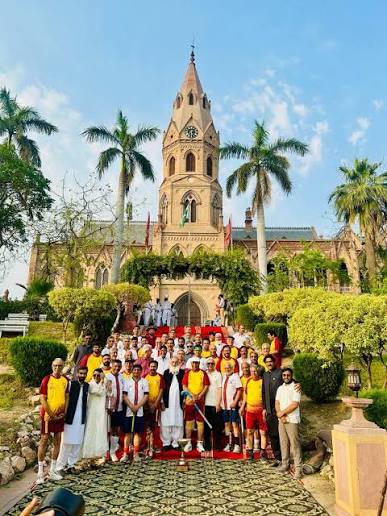 Beyond the alumni meet itself, the Old Ravians Association, under the leadership of President Athar Ismaeel and his Executive Committee, is organising a prestigious evening of poetry and literature at Bukhari Auditorium, GCU Lahore.
The literary sitting will be presided over by renowned Pakistani poet Iftikhar Arif and will bring together some of the country’s distinguished poets, including Yasmeen Hameed, Abbas Tabish, Khalid Sharif, Rakhshanda Naveed, Simab Zafer and Fariya Naqvi.
The historic Bukhari Auditorium will be specially adorned for the occasion, creating a memorable evening celebrating poetry, literature and the glorious traditions of Government College University Lahore — a fitting complement to the alumni meet and a further reminder that the Ravian spirit lives as much in verse as in public service.
An Institution, Not a Nostalgic Ceremony
The 3 September Ravian Alumni Meet should therefore be viewed as a celebration of a living institution rather than a nostalgic ceremony. It is an occasion to recognise those who have carried the Ravian spirit into their professions and communities, and to inspire younger generations to understand that education is ultimately measured by the quality of contribution one makes to society — at home and, as Iqbal, Salam and Khorana showed, on the world stage.
Athar Ismaeel’s leadership of the Old Ravians Union is especially meaningful in this context. As RPO Sheikhupura, he represents public service; as a Ravian, he represents intellectual heritage; and as President of the alumni union, he represents continuity between generations. His journey, and that of Vice Chancellor Omer Chaudhry guiding the institution today, together capture the essence of the event.
The old Ravians who assemble in Bukhari Auditorium on 3 September will bring with them different stories, professions and achievements. But beneath those differences will lie a common identity — one shaped by the same historic institution and by the same conviction that knowledge must be accompanied by courage, character and service.
The world may remember GCU through its Nobel laureates, poets, philosophers, statesmen, scientists, administrators, artists and public figures. Pakistan may remember its Ravians through their individual achievements. But perhaps the most enduring success story is the institution’s ability to produce generations who continue to believe that education is not merely a pathway to personal success; it is a responsibility to society.
The Ravian Alumni Meet will thus be a celebration of yesterday’s memories, today’s achievements and tomorrow’s possibilities. When the doors of Bukhari Auditorium open at 4 p.m. on 3 September, generations of Ravians will once again meet. Some will be carrying medals, titles and distinguished careers. Others will carry nothing more than memories of youthful dreams. Yet for a few precious hours, professional designations will become secondary.
They will simply be Ravians. And in that moment, the historic walls of Government College University Lahore will once again tell the story of an institution whose greatest achievement is not its age, architecture or reputation — but the people it continues to send into the world.
The author is Former Professor and Head, Department of Entomology, University of Agriculture Faisalabad. He can be reached at [email protected]

