



University of Kamalia’s Global Initiative to Transform Waste into Wealth
The world stands at a watershed moment. Climate change, resource depletion, and runaway waste generation are converging to demand a fundamental restructuring of how economies produce, consume, and discard. The circular economy — which replaces the linear “take, make, dispose” model with systems that keep materials in productive use — has moved from academic concept to urgent policy imperative. The European Union’s Circular Economy Action Plan targets a 55 percent municipal waste recycling rate by 2025. China’s “Beautiful China” initiative has channelled over USD 60 billion into circular infrastructure since 2015. These are not merely environmental pledges; they represent a profound competitive restructuring of the global economy.
Against this backdrop, Pakistan’s First International Conference on Recycling, scheduled for 10 June 2026 at Serena Hotel Faisalabad, arrives at precisely the right moment. Jointly convened by the University of Kamalia (UKM), Government College University Faisalabad (GCUF), and Government College Women University Faisalabad (GCWUF), the conference brings together policymakers, industrialists, researchers, entrepreneurs, and international experts to forge practical pathways toward a circular and sustainable Pakistan.
A Conference of National Consequence
Pakistan generates over 30 million tonnes of solid waste annually, yet its formal recycling sector recovers less than 20 percent of retrievable materials — a multi-billion-dollar gap that signals both crisis and opportunity. More than 300 participants are expected, including 80 to 100 CEOs and senior industry leaders, underscoring that recycling is no longer an environmental afterthought but a strategic economic imperative bearing directly on competitiveness, exports, and investment.
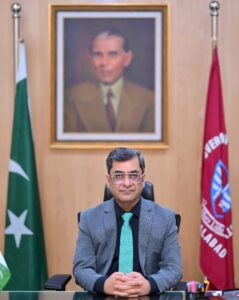
The conference convenes under the leadership of Professor Dr. Yasir Nawab (Vice Chancellor, UKM), Professor Dr. Rauf-i-Azam (Vice Chancellor, GCUF), and Professor Dr. Kanwal Ameen (Vice Chancellor, GCWUF) — a triumvirate whose collaboration models a new standard for how Pakistani universities can jointly address national challenges through research, policy engagement, and industry partnership.
Global Lessons, Local Urgency
The conference draws on international expertise from Germany, the United Kingdom, the Netherlands, Estonia, Kenya, and Sri Lanka — nations that have converted waste challenges into economic engines. Their experiences are directly instructive for Pakistan.
Germany’s Dual System achieves a 70 percent packaging recycling rate and sustains over 250,000 green jobs, demonstrating that robust producer-responsibility frameworks generate employment at scale. The Netherlands has committed to halving consumption of virgin raw materials by 2030 through its National Circular Economy Programme — a model for a country seeking to cut its import bill for primary commodities. Estonia’s digital waste-traceability infrastructure has reduced illegal dumping by 40 percent, a lesson with immediate relevance for Pakistan’s informal waste sector.
Beyond Europe, Japan’s “Sunshine Project” extracts precious metals worth over USD 6 billion annually from electronic waste, making e-waste recovery a sovereign resource strategy. South Korea recycles 95 percent of its food waste, converting it into biogas and agricultural compost — a model applicable to Pakistan’s organic-rich municipal waste streams. Singapore has achieved a 60 percent overall recycling rate through mandatory producer responsibility and public education, demonstrating that even land-scarce, resource-poor nations can build world-class circular systems.
Pakistan’s own numbers make the urgency undeniable. The country produces approximately 49,000 tonnes of solid waste daily; less than half is collected in urban areas, and virtually none is treated in rural zones. Plastic pollution alone costs the fishing and tourism industries an estimated USD 1.3 billion per year. Meanwhile, Pakistan’s textile sector — contributing 8 percent of GDP and over 60 percent of export earnings — generates roughly 400,000 tonnes of fabric waste annually. That material could anchor a recycled-fibre industry worth hundreds of millions of dollars.
 University of Kamalia: An Emerging National Model
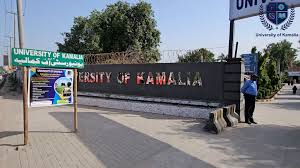 University of Kamalia: An Emerging National Model
Among the conference’s convening institutions, the University of Kamalia has emerged as one of Pakistan’s most dynamic public universities. Under Professor Dr. Yasir Nawab’s leadership, UKM has pursued a strategy centred on innovation, digitalisation, sustainability, and community impact — mirroring best practices from Wageningen University in the Netherlands, ranked among the world’s top institutions for sustainability research, and South Korea’s KAIST, which has commercialised research through partnerships with over 1,000 companies.
With fully smart and air-conditioned classrooms, modern laboratories, active learning management systems, and strong industry linkages, UKM is equipping students for the twenty-first century economy. Its emphasis on entrepreneurship from Year One has already produced more than thirty student startups, several with secured funding — a trajectory reminiscent of the early stages of Jordan’s King Abdullah University of Science and Technology, whose entrepreneurship programme now supports over 200 active ventures.
The First International Conference on Recycling exemplifies UKM’s “entrepreneurial university” model — a concept endorsed by the World Bank and UNESCO as essential for linking higher education to national development outcomes. Rather than confining itself to instruction, UKM is positioning itself as a catalyst for regional transformation through interdisciplinary collaboration and stakeholder engagement. Professor Dr. Yasir Nawab deserves recognition for championing this model: integrating higher education with economic growth, environmental stewardship, and social well-being.
 GCUF: Research, Innovation and Industrial Transformation
 GCUF: Research, Innovation and Industrial Transformation
Government College University Faisalabad brings deep expertise in textile science, waste management, industrial sustainability, and resource recovery. Through growing international collaborations and strong industry linkages, GCUF translates research into practical circular-economy solutions. Its role in academia-industry technology transfer and cleaner production is essential to Pakistan’s industrial decarbonisation agenda.
 Women’s Leadership as a Circular Economy Multiplier
 Women’s Leadership as a Circular Economy Multiplier
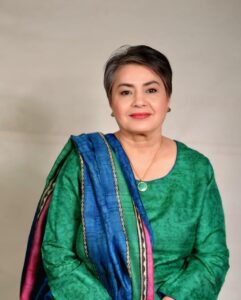
The participation of Government College Women University Faisalabad, under Professor Dr. Kanwal Ameen, adds a dimension of strategic importance that the data consistently validates. The United Nations Environment Programme has documented that communities with strong women’s leadership in waste management achieve recycling rates 20 to 35 percent higher than comparable communities without it. Rwanda’s nationally coordinated, women-led waste collection network has made it one of Africa’s cleanest nations — proof that gender-inclusive governance is not merely ethical but operationally superior.
GCWUF’s established programmes in home economics, environmental sciences, and social entrepreneurship already equip female graduates to engage sustainability challenges at household, community, and industrial levels. Scaling these programmes and integrating them into formal circular-economy value chains represents a powerful, underutilised lever for Pakistan’s green transition.
Circular Faisalabad: From Industrial Liability to Global Showcase
Faisalabad — Pakistan’s industrial heartland and third-largest city — encapsulates both the urgency and the opportunity of circular transformation. Its 700-plus textile mills, dyeing units, and allied industries generate vast volumes of liquid effluent, fibre waste, chemical by-products, and packaging, much of it currently discharged without recovery. Yet the city’s entrepreneurial culture, dense industrial clusters, and proximity to major agricultural zones create ideal conditions for piloting circular business models.
Kalundborg, Denmark — the world’s first industrial symbiosis ecosystem — shows the way. There, waste outputs from one firm serve as productive inputs for neighbouring enterprises, cutting costs, slashing emissions, and generating new revenue. A Faisalabad Industrial Symbiosis Network, modelled on Kalundborg, could transform the city into a regional circular economy showcase. Similarly, Nairobi’s Reppie Waste-to-Energy Plant offers a scalable template for converting Faisalabad’s organic-rich municipal waste into power and compost, closing the nutrient loop between the city and its surrounding agricultural belt.
A Defining Window for Pakistan
Pakistan stands at a rare inflection point. Mounting waste costs, fiscal pressure on virgin-material imports, tightening environmental standards from trading partners — notably the EU’s Carbon Border Adjustment Mechanism — and a youthful, entrepreneurially inclined population create a compressed window for transformative action. The World Economic Forum estimates that a global circular transition could generate USD 4.5 trillion in economic value by 2030. For Pakistan, capturing even a modest share through targeted policy reform, industrial innovation, and strategic academic-industry partnership could yield an estimated 500,000 new jobs by 2035, meaningfully higher export revenues, and a 15 percent reduction in annual raw-material import costs.
Artificial intelligence-driven waste sorting, chemical recycling of plastics, waste-to-energy systems, bio-refineries, and digital traceability platforms are reshaping resource management globally. With 63 percent of its population under 30 and an expanding research ecosystem, Pakistan has the demographic dividend and the industrial base to adopt and localise these technologies at scale.
The First International Conference on Recycling is therefore far more than an academic convening. It is an opportunity for Pakistan to articulate a credible national vision for the circular economy, forge the partnerships needed to realise it, and signal to global investors and trading partners that sustainable industrial development is a serious national commitment.
The University of Kamalia, Government College University Faisalabad, and Government College Women University Faisalabad, through this initiative, are laying the intellectual and institutional foundations for Pakistan’s circular future. That is a contribution of enduring national significance.
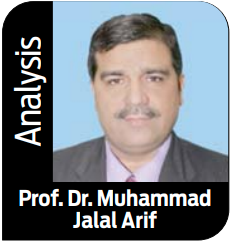
About the Author:Professor Dr. Muhammad Jalal Arif,Former Professor and Chairman, Department of Entomology, University of Agriculture Faisalabad,Consultant, Punjab Higher Education Commission (PHEC)