

Dr. Waseem Khokhar
There is no doubt that religion plays a pivotal role in both domestic and international politics. This narrative has long dominated the discourse in the Muslim world, particularly within West and South Asia. However, the conflict between the U.S., Israel, and Iran is not fundamentally a religious war. If it were, Iran would not have targeted other Islamic nations in the Gulf, nor would various European countries have declined to join the U.S.-led efforts against Tehran. Consequently, it is inaccurate to frame this confrontation through a purely religious lens.
While the role of religion cannot be ignored in a world focused on identity, it is not the primary driver of this conflict. In the contemporary world order—characterized by technological competition and the race for resources—national interests remain the core of realpolitik.
Iranian strategists currently face a dilemma: how to maximize power while avoiding the Thucydides Trap. This historical concept describes the Peloponnesian War, where Sparta (the hegemon) attacked a rising Athens out of fear and mistrust. Similarly, Iran’s regional ambitions and its nuclear program instill deep-seated apprehension among its neighbors and pose a direct challenge to U.S. hegemony in the Middle East. For Iran, this struggle is framed as a matter of survival, leading it down the path of “strategic resistance.”
The Concept of the “Hibernated War”
The current state of the conflict—characterized by a partial pause in direct military engagement—can best be defined as a Hibernated War. I have coined this term to describe the inherent complexity of the situation. While much has been written about the conflict in 2026, the current atmosphere remains one of profound uncertainty.
The Middle East is the world’s energy hub, supplying approximately 20% of global energy needs. Currently, energy trade has reached a standstill due to the closure of the Strait of Hormuz—a vital geopolitical chokepoint—by Iran, compounded by a U.S. naval blockade. This objective reality has pushed Iran to the brink; its infrastructure has been devastated by U.S.-Israeli aerial strikes, and its economy is nearing total collapse.
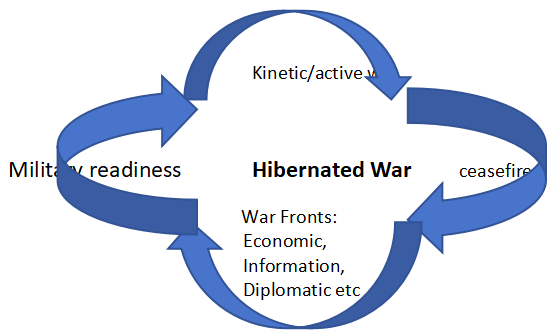
In this state of “Hibernated War,” the warring parties have entered a period of undetermined peace talks following a ceasefire. However, they continue to battle across multiple non-kinetic fronts:
Economic: Sanctions and blockades.
Information: Propaganda and narrative control.
Diplomatic: Regional maneuvering and international lobbying.
While the guns are momentarily silent, militaries remain in a state of high readiness, prepared to resume strikes at a moment’s notice. In this “hibernation,” parties continue to pursue their national interests through shadow warfare rather than open combat.
The Path Forward
The United States appears to have achieved several of its covert strategic objectives. Conversely, Iran must now reassess its strategy. An internal rift between political leadership and the Islamic Revolutionary Guard Corps (IRGC) has made navigating this quagmire increasingly difficult.
Meaningful peace talks are not just beneficial for Iran; they are essential for regional stability and global peace. As Sun Tzu wrote in The Art of War, the supreme art of war is to subdue the enemy without fighting. While conflict sometimes seems inevitable, the ultimate solution always lies at the negotiation table.
The writer is an Head, Department of International Relations, MY University, Islamabad. He can be reached at [email protected].

