



Kazakhstan Strengthens Investment Climate with Digital Reforms, AI Development and Major Infrastructure Initiatives
 President Kassym-Jomart Tokayev has reaffirmed Kazakhstan’s commitment to sustainable economic growth, digital transformation and foreign investment while addressing the 38th plenary session of the Foreign Investors’ Council.
Speaking before international investors, business leaders and development partners, President Tokayev said Kazakhstan remains focused on adapting to the rapidly changing global economic and political landscape while maintaining macroeconomic stability and strengthening investor confidence.
He highlighted the country’s strong economic performance, noting that Kazakhstan’s Gross Domestic Product (GDP) grew by 6.5 percent last year and has now surpassed the $300 billion mark. He added that Kazakhstan continues to lead Central Asia in attracting foreign direct investment, having accumulated more than $150 billion in net FDI—representing nearly 70 percent of all foreign investment flowing into the region.
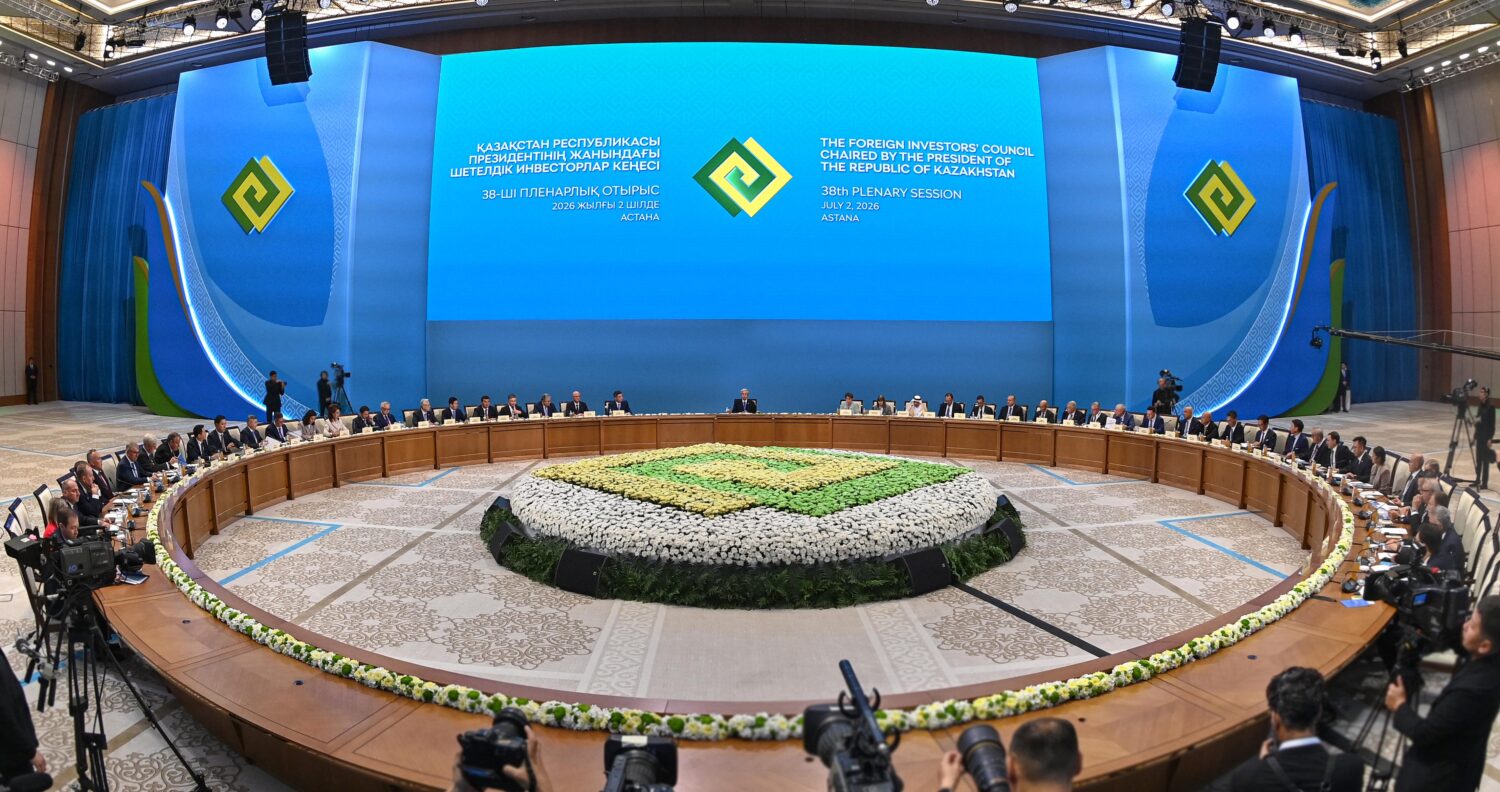
The President said the country’s economic achievements are underpinned by political stability and constitutional reforms that provide stronger legal protection for investors. He also announced the launch of the National Digital Investment Platform, designed to serve as a one-stop digital gateway for investors and streamline investment procedures.
President Tokayev said Kazakhstan offers long-term incentives for international businesses, including the Altyn Visa program, which provides tax advantages and simplified migration procedures for foreign investors. He stressed, however, that the government remains committed to further reforms to improve the investment environment.
A major focus of the President’s address was Kazakhstan’s ambition to become a regional leader in artificial intelligence and digital innovation. Declaring 2026 as the Year of Artificial Intelligence and Digital Development, he said AI would play a central role in public administration, education, investment promotion and industrial modernization.
To support this vision, Kazakhstan has established a Ministry of Artificial Intelligence and Digital Development and launched an AI Development Council. The government has also introduced a Digital Code, a new Artificial Intelligence Law and the Digital Qazaqstan Strategy to provide a comprehensive framework for technological advancement.
President Tokayev announced that Kazakhstan has successfully launched two advanced supercomputers and is developing a Data Center Valley, which has already attracted global technology companies including Amazon and G42.
He emphasized that investment in human capital remains a national priority. Kazakhstan has opened next-generation educational institutions, including Tumo and the Tomorrow School, while introducing AI into the national education system. The country is also establishing Central Asia’s first specialized Artificial Intelligence University to develop future technology leaders.
The President highlighted AI-driven modernization across multiple sectors, including logistics, agriculture, oil and gas, financial services and manufacturing. He noted that the Smart Cargo digital platform is transforming Kazakhstan’s transport corridors by digitizing customs and logistics procedures, reducing transit times and improving efficiency along key Eurasian trade routes.
Kazakhstan is also expanding its role in the global critical minerals market by digitizing geological records, introducing AI-powered exploration technologies and creating a Regional Research Center for Rare Earth Metals in Astana to attract international investment.
In agriculture, President Tokayev said precision farming, drones, satellite technology and AI-powered forecasting have helped Kazakhstan achieve record grain harvests of 27 million tonnes for two consecutive years. The government is now accelerating the digital transformation of agriculture while promoting smart farming and value-added food processing industries.
Highlighting infrastructure development, the President reaffirmed Kazakhstan’s ambition to become a major logistics hub connecting Europe and Asia. More than 85 percent of China-Europe rail freight passes through Kazakhstan, supported by investments exceeding $35 billion in transport and logistics infrastructure over the past 15 years.
President Tokayev also presented the vision for Alatau City, which is being developed as Kazakhstan’s first fully digital city. The project will feature advanced digital governance, integrated public services and a regulatory framework supporting cryptocurrency exchanges, digital assets and financial innovation.
Concluding his address, President Tokayev stressed that artificial intelligence and digital sovereignty will be key drivers of Kazakhstan’s long-term economic resilience and competitiveness. He called for stronger collaboration between the government, international investors and the private sector to accelerate reforms, foster innovation and build a prosperous digital economy.
The plenary session was also addressed by senior representatives of the European Bank for Reconstruction and Development (EBRD), the Asian Development Bank (ADB), Citi, China National Petroleum Corporation (CNPC) and Air Liquide, reflecting broad international support for Kazakhstan’s investment and digital transformation agenda.
The writer is Editor, Daily The Spokesman; Managing Editor, Daily Imroze; Founder President, Tourism Association of Pakistan; and Convener, FPCCI Standing Committee on Heritage & Hospitality.