



An Exclusive Interview with NAVTTC Chairperson Gulmina Bilal
By Amjad Mehmood Photo by Sultan Bashir
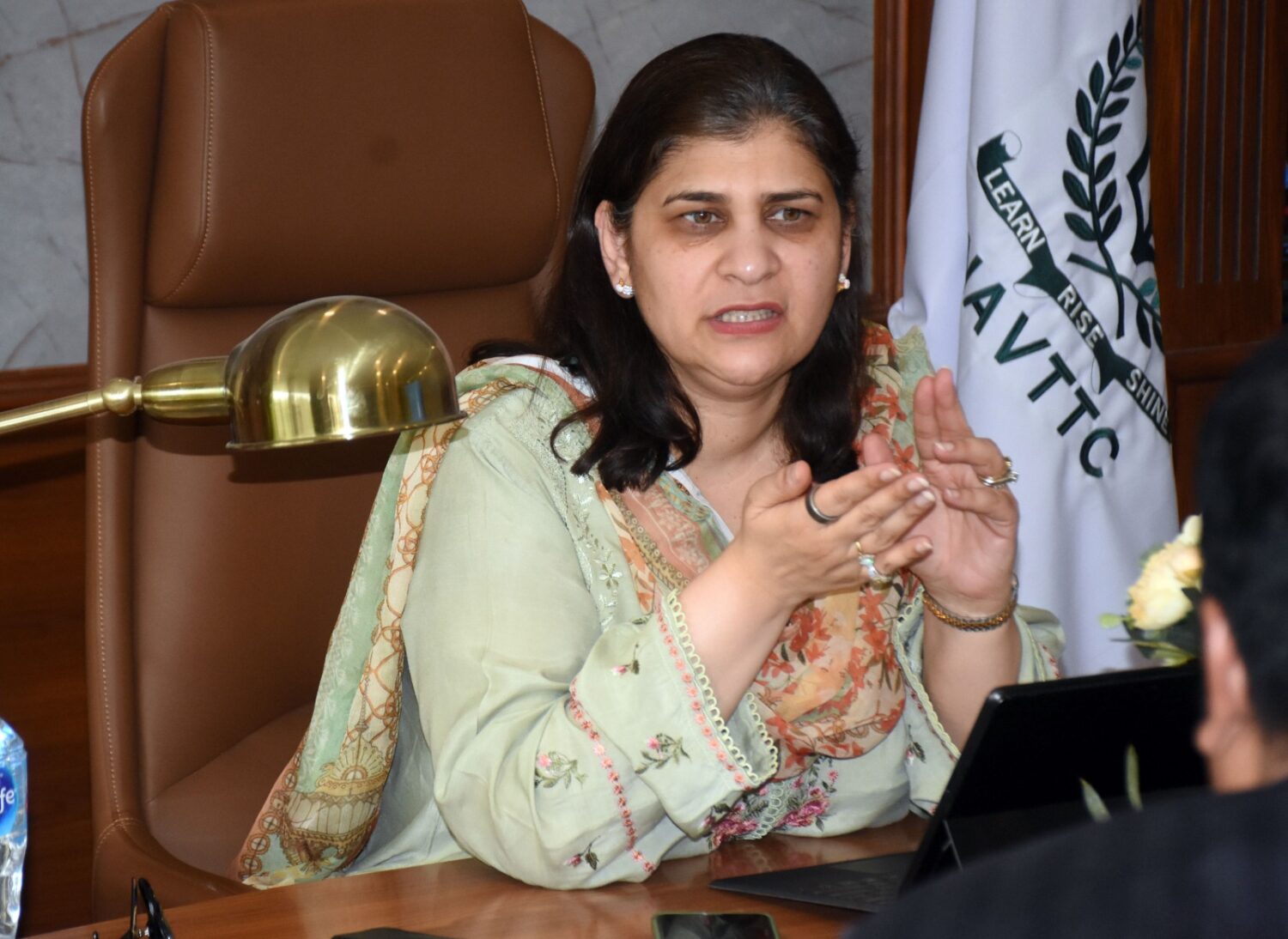
—Ms. Gulmina Bilal, Chairperson of Pakistan’s National Vocational and Technical Training Commission (NAVTTC), is at the forefront of efforts to transform the country’s human capital through skills development and vocational training. Known for her dynamic leadership and longstanding commitment to governance reform and social development, she brings decades of experience from the public policy and civil society sectors. At a time when Pakistan’s youthful population represents both a challenge and an opportunity, she is championing a national vision to equip millions of young Pakistanis with market-relevant skills, strengthen industry linkages, and position the country’s workforce to compete in an increasingly technology-driven global economy. Her leadership at NAVTTC reflects a broader effort to reshape Pakistan’s technical and vocational education system into a catalyst for economic growth, employment generation, and inclusive development.
 In an exclusive interview with Daily The Spokesman, Ms. Gulmina Bilal outlined the commission’s initiatives to strengthen skills development and improve employment opportunities for Pakistani youth.
Introducing NAVTTC, she said the commission serves as the federal regulatory body responsible for promoting technical and vocational education and skills training across the country. Through a wide range of training programs and partnerships with public and private institutions, NAVTTC aims to enhance employability and expand job opportunities for individuals while strengthening Pakistan’s skilled workforce. “In many ways, NAVTTC functions as a regulatory authority similar to how institutions such as PTA and PEMRA regulate their respective sectors,” she explained. “Our responsibility is to ensure quality by setting standards for training institutions, including curriculum benchmarks, faculty qualifications, and training delivery. This helps maintain a minimum professional threshold for teachers and training providers so that students receive industry-relevant skills.” She said that NAVTTC has been performing this regulatory role since its establishment in 2005.
 She added that the commission is also mandated to plan and implement the Prime Minister’s Youth Skill Development Program, which aims to equip young people with market-relevant skills. NAVTTC manages and disburses resources for these initiatives to ensure training opportunities reach intended beneficiaries across the country. She explained that following Pakistan’s 18th Constitutional Amendment, provincial Technical Education and Vocational Training Authorities (TEVTAs) operate independently within their respective provinces. However, NAVTTC continues to serve as the national regulatory authority for skills development, while provincial TEVTAs function primarily as implementing bodies. Under the Prime Minister’s Youth Skill Development Program, NAVTTC collaborates with public sector organizations and universities to provide training in various trades. While the commission provides funding support for certain initiatives, provincial authorities also conduct their own programs through provincial budgets.
She emphasized that these programs are equipping young people with market-relevant skills while expanding opportunities for women in traditionally male-dominated trades. “Trades such as plumbing, mobile repair, carpentry, and electrical work, which were once considered male-dominated, are now being offered through women-only training programs,” she said. “Launched last year as a pilot under the Prime Minister’s directive, the initiative has now become a regular part of NAVTTC’s training portfolio.” She added that several advanced IT and modern skills programs have also been introduced, drawing inspiration from successful training models in China.
“Our priority is to ensure trainees receive proper hands-on training and acquire the practical skills required in their trades”
Highlighting a shift in approach, she said NAVTTC is now focusing on preparing work-ready youth rather than simply issuing certificates. “In the past, the emphasis was largely on training numbers and certification, with less attention to whether trainees were actually ready for employment,” she said. “We have changed that approach. Our priority is to ensure trainees receive proper hands-on training and acquire the practical skills required in their trades. We also actively facilitate their placement in relevant industries, both within Pakistan and abroad.”
Since July 2025, NAVTTC has been working to update curricula and introduce internationally recognized certifications in various trades. The commission has also accredited several new training organizations that meet its quality and compliance standards.
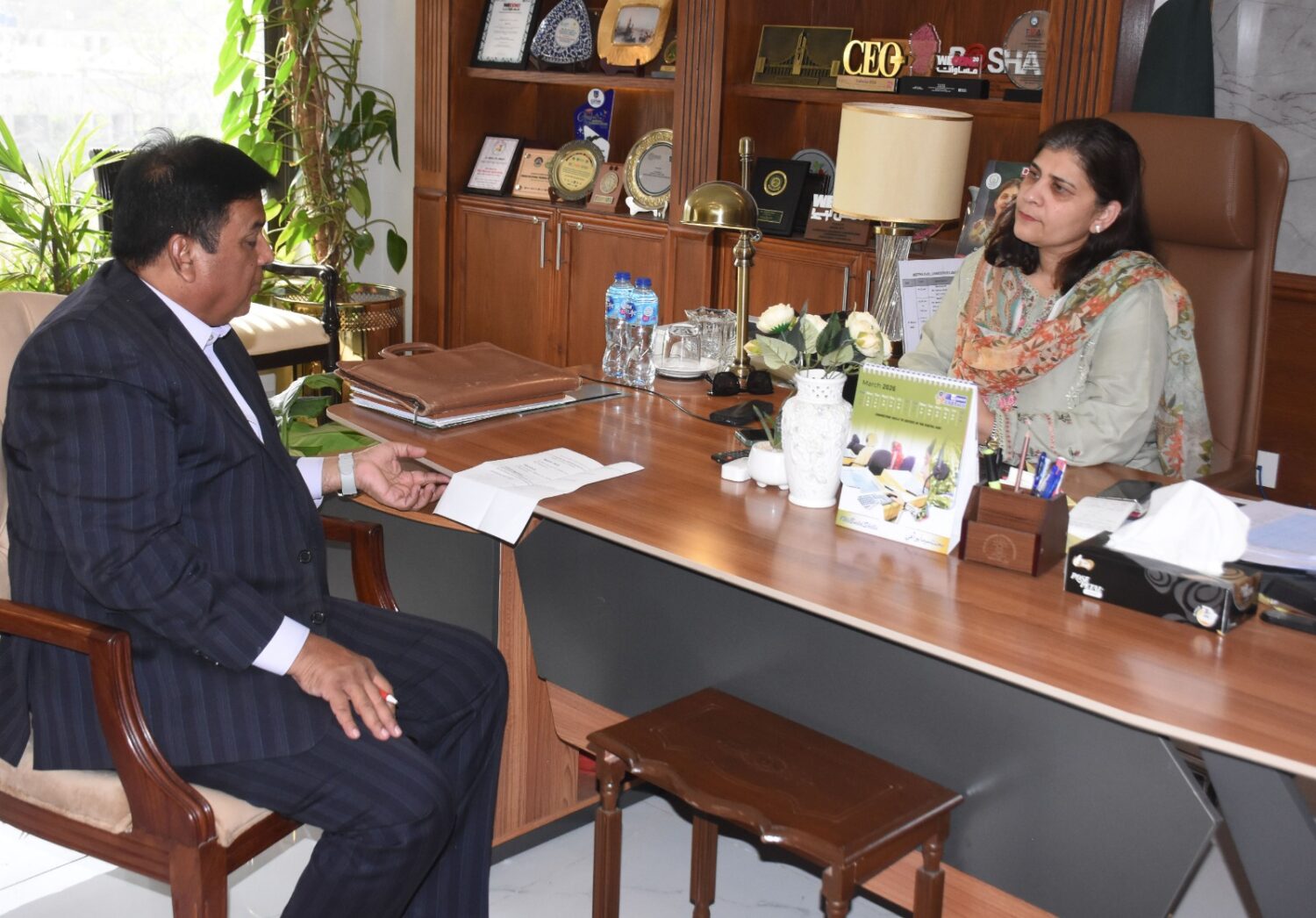 Explaining the accreditation process, Bilal said organizations seeking registration must apply through NAVTTC’s digital management information system and submit evidence-based documentation. Applications are evaluated for faculty qualifications, infrastructure, and training capacity before on-site inspections are conducted. “Successful applicants are registered upon payment of a fee valid for three years,” she said. “Once accredited, they become recognized partners on the NAVTTC portal and can offer authorized training courses.”
Addressing allegations in the past regarding fake students and certifications, she said strict monitoring mechanisms have been introduced to ensure transparency. Biometric attendance systems have been implemented for students, and cameras are now mandatory in classrooms and laboratories to verify the authenticity of training activities. Payments are withheld from organizations that fail to comply with these requirements. NAVTTC also conducts regular monitoring and third-party audits to ensure programs are delivered transparently and credibly.
“Transparent, focused, and industry-aligned training programs are integral part of NAVTTC”
She acknowledged that concerns regarding fake certificates had previously been raised, but said the issue has now been addressed through the issuance of certificates on secure security-paper pages with verifiable features designed to prevent forgery.
Discussing the selection of training providers, she said NAVTTC issues trade-specific advertisements inviting applications from registered organizations. Industry experts evaluate the competing institutes, and the most qualified organizations are selected to conduct training programs.
Speaking about the Skill Verification Program run by Takamol Holding of Saudi Arabia, she said the initiative verifies the skills of foreign workers before the issuance of work visas. Under the system, skilled workers must pass practical and theoretical tests in their country of origin to confirm their competence. Testing centers have been established across Pakistan, enabling applicants to appear for examinations at nearby facilities. However, she added that one of the key challenges is that most tests are conducted in English, which creates difficulties for skilled workers who possess strong practical expertise but lack formal education in the language. NAVTTC is currently in discussions with Takamol authorities to introduce testing in national and regional languages to make the process more accessible.
She added that the entire testing process is now recorded and can be monitored online by Takamol officials, addressing earlier complaints of irregularities and improving transparency. NAVTTC has also launched preparatory training sessions to help Pakistani workers better understand the test format and increase their chances of success. Workers who obtain the Takamol certificate can then apply for employment visas for Saudi Arabia. Pakistan, she added, was the first country to sign the Skill Verification Program agreement with Takamol when the Kingdom introduced mandatory skill verification in July 2021.
On international certification, she said such opportunities were previously limited within NAVTTC programs. The commission has now introduced internationally recognized certifications in trades where standardized global frameworks exist, enabling trainees to obtain credentials accepted in international labor markets. She also highlighted efforts to strengthen industry linkages. “When I assumed office, one of the key gaps at NAVTTC was the lack of strong industry alignment,” she said. “Bridging this gap became a priority.” On-the-job training with relevant industries has now been made mandatory, and partnerships have been established with sectors including textiles, pharmaceuticals, and manufacturing to ensure students gain practical experience.
Discussing proposed amendments to the Apprenticeship Act, she said NAVTTC presented reform proposals during its January 2026 board meeting. The commission’s legal team drafted amendments aimed at making the law more effective and practical. The proposed reforms would require industries above a certain size to allocate mandatory apprenticeship slots, enabling trainees to receive structured on-the-job training aligned with industry needs.
“Commercial attachés at Pakistani embassies can play an important role in promoting Pakistani skilled labor internationally”
She also stressed the need for stronger coordination with Pakistani missions abroad to expand overseas employment opportunities for skilled workers. “Commercial attachés at our embassies can play an important role in promoting Pakistani skilled labor internationally,” she said. “Their engagement can help secure more employment visas for workers trained through NAVTTC programs.”
Responding to a question on funding and sustainability, she said the key challenge is not the availability of resources but their efficient utilization. Decisions, she said, are increasingly guided by data on district-level needs and labor market demands. NAVTTC has developed an online platform that provides real-time information on training institutions across Pakistan. The system allows officials to review data on training capacity, faculty qualifications, and operational status of institutes across districts, from Sanghar to Dalbandin.
Highlighting major initiatives, she said the Prime Minister’s Youth Skills Development Program remains a flagship project providing free vocational training to young people nationwide. The program is implemented through more than 1,000 training institutes and offers over 250 courses, ranging from emerging technologies such as artificial intelligence and robotics to traditional trades like hospitality and welding. She also referred to the National Employment Exchange Tool (NEXT), an online platform designed to connect skilled youth with potential employers and expand employment opportunities.
Ms. Gulmina concluded the interview by highlighting NAVTTC’s role in implementing the URAAN Pakistan Program, which focuses on equipping diverse groups, including boys, girls, madrasa students, and differently abled individuals with future-oriented skills such as information technology, game development, artificial intelligence, and other high-tech trades. Referring to international cooperation, she said Pakistan continues to benefit from strong support from China. “Pakistan doesn’t walk alone,” she said. “China has been walking with us like family.”