



“In an age when Rwanda registers land in a single day and Georgia does it through blockchain, Punjab’s 110 million land parcels stand at the threshold of a comparable transformation.”
The Board of Revenue (BOR), Punjab, is one of the oldest and most consequential institutions in Pakistan’s system of governance. For more than a century and a half, it has served as the principal authority for land administration, revenue management, disaster relief, settlement operations, and district administration across the province. Governments have changed, administrative structures have evolved, yet the Board has continued to adapt through institutional reform, technological innovation, and citizen-centric service delivery. What distinguishes the present moment, however, is the scale and pace of digital transformation now underway — and the opportunity this creates to measure Punjab’s performance against national data and international benchmarks.
The origins of the Board of Revenue trace back to the British colonial administration of the nineteenth century, when an organized land revenue system became essential to governance. Following independence in 1947, the institution was retained and strengthened to serve the people of Punjab. Today it functions under the Punjab Government’s Rules of Business as the apex organization for land records, revenue administration, relief operations, and coordination with district administrations, overseeing a rural cadastral base of roughly 55,000 mouzas (revenue estates) across the province.
 A National Benchmark: Where Pakistan Stands
Reliable land administration is not merely an administrative convenience; it is measured internationally and its performance carries economic consequences. According to the World Bank’s Doing Business assessment, registering property in Pakistan requires six procedures and takes approximately fifty days to complete, at a cost of roughly 5.29 percent of the property’s value — placing the country around the 97th position globally on this specific indicator. Each of these numbers represents friction: lost time for citizens, discouraged investment, and space for informal intermediaries to insert themselves into transactions that should be simple and transparent.
The contrast with international good practice is instructive rather than discouraging. Rwanda completed a nationwide land tenure regularization programme and now processes the overwhelming majority of land transactions within a single day through a fully digital registry. Georgia’s National Agency of Public Registry has built one of the world’s most trusted blockchain-backed title systems, consistently placing the country among the global top five for ease of property registration. New Zealand’s Landonline platform, a fully electronic cadastre, is treated by the World Bank itself as a ‘good practice’ reference point for other economies. These are not aspirational abstractions for Punjab — they are functioning systems whose architecture, sequencing, and citizen-facing design can be studied and adapted.
 Punjab’s Digital Transformation: The Numbers
Punjab’s own reform trajectory has accelerated meaningfully. By the middle of 2025, digitization of rural property records had crossed the 80 percent mark province-wide, with districts including Bahawalpur, Bahawalnagar, Sargodha, and Multan reporting near-complete coverage. The provincial government has targeted full digitization coverage in the near term, and from July 1, 2026, the Punjab Land Records Authority’s Green Property Certificate and Property Report — issued under the Management of Land Records Regulations 2025 — became the instrument of record for land transactions in most districts, replacing the traditional Fard extract for transactional purposes.
 This transformation is being carried forward through the Punjab Urban Land System Enhancement (PULSE) programme, supported by the World Bank, which is extending parcel-based mapping, drone-assisted surveying, GIS integration, and digitization of urban and katchi abadi (informal settlement) records — areas historically excluded from systematic land administration. In Rawalpindi division alone, well over three-quarters of mouzas had completed digitization under this initiative, with the remainder targeted for closure in the current phase. Complementary investments in Continuously Operating Reference Stations for satellite-based surveying, enterprise cybersecurity certification, and Arazi Record Centre infrastructure signal that this is a systemic modernization rather than a piecemeal digitization drive.
Pakistan’s experience also sits within a wider South Asian pattern. India’s Digital India Land Records Modernization Programme has extended computerized record-keeping across more than two dozen states and union territories, including Indian Punjab, demonstrating that federal or provincial land systems of comparable scale and colonial-era origin can be modernized in phases without disrupting ongoing administration. The lesson for Punjab is one of sequencing: digitize the record, then re-engineer the transaction, then integrate the databases — each phase building legitimacy for the next.
The Institutional Mandate
 Beyond digitization, the Board of Revenue carries a wide statutory mandate: land revenue assessment and collection, maintenance of land records, supervision of revenue officers, settlement and consolidation of holdings, mutation and registration, management of state lands, and the implementation of relief and rehabilitation measures during floods, earthquakes, and droughts. The institution’s role in disaster response — coordinating damage assessment, compensation, and rehabilitation through the district administration — makes it one of the most operationally significant pillars of public administration in the province, engaging directly with millions of affected citizens in periods of acute need.
The Senior Member Board of Revenue (SMBR) serves as the administrative head of the institution, working closely with the Chief Minister, Chief Secretary, Commissioners, Deputy Commissioners, and revenue officers to translate provincial policy into implementation at the grassroots level. At present, Mr. Nabeel Javed, Senior Member Board of Revenue, is providing dynamic administrative leadership to the institution. His professional competence and commitment to good governance have strengthened the Board’s performance, with a visible emphasis on digital governance, accountability, institutional discipline, and citizen facilitation that reflects the evolving role of land administration in a modern state. His innovative governance style is distinguished by a readiness to embrace data-driven monitoring of revenue offices, encourage e-mutation uptake at the tehsil level, and cultivate a culture of responsiveness in which citizen grievances are tracked to resolution rather than left to languish in file registers.
The province’s administrative machinery is further anchored by Chief Secretary Punjab Mr. Zahid Akhtar Zaman, whose coordination role across departments ensures that policy directives from the Chief Minister’s office are translated into disciplined execution at the district and tehsil level, reinforcing the accountability architecture on which land-record reform ultimately depends.
The Board is also benefiting from the dedicated services of Mr. Shafqatullah Mushtaq, Secretary, Board of Revenue, whose administrative expertise contributes to institutional coordination, policy implementation, and responsive governance across the organization’s various wings, and whose steady hand on inter-departmental liaison has helped keep reform milestones on schedule.
“Secure land records are not a bureaucratic convenience; internationally, they are treated as a precondition for investment, credit access, and rural prosperity.”
Why Land Governance Drives Economic Outcomes
 International development literature consistently identifies secure and transparent land tenure as a precondition for broader economic activity: it underpins access to formal credit, since land serves as the principal collateral for smallholder and small-business lending across South Asia; it reduces litigation, given that a substantial share of civil court backlogs in Pakistan originates in land and inheritance disputes traceable to ambiguous or contested records; and it improves the ease of doing business ranking that shapes foreign and domestic investment decisions. Punjab, as Pakistan’s agricultural heartland, has a particular stake in this: secure ownership records directly affect access to agricultural credit, irrigation investment, and the mechanization decisions of farming households.
The vision articulated by Chief Minister Punjab Maryam Nawaz Sharif — emphasizing transparency, digital transformation, ease of doing business, and citizen welfare — aligns closely with this evidence base. Her administration has prioritized land-record modernization as a flagship governance reform, treating the Green Property Certificate regime and the PULSE programme as tangible markers of a wider commitment to paperless, corruption-resistant public service delivery, and directing that citizen facilitation rather than procedural delay define the Board’s public interface. Implementation, however, depends on coordinated execution by the Board of Revenue, Commissioners, Deputy Commissioners, Assistant Commissioners, and revenue officers across all forty-one districts of the province, translating policy direction into the measurable outcomes that international indices actually track.
A Roadmap for Strengthening the Board
Drawing on both the trajectory already underway in Punjab and the comparative international experience, several priorities stand out as the natural next phase of reform:
- Complete the digitization of urban land records with the same rigor already applied to rural Jamabandi, closing the gap that has historically left cities without spatial title information.
- Integrate GIS, satellite mapping, and Continuously Operating Reference Stations into a single national-standard cadastral layer, following the parcel-based model already piloted under PULSE.
- Reduce the fifty-day, six-procedure registration process toward the one-to-two-day standard achieved in Georgia and New Zealand, primarily by eliminating redundant physical verification steps now made unnecessary by digital records.
- Extend blockchain or tamper-evident ledger technology to title records, addressing the transparency and dispute-resolution dimensions on which Pakistan scores weakest internationally.
- Strengthen grievance redressal mechanisms and community engagement, building on the Board’s own GRM and social mobilization initiatives now being procured under PULSE.
- Invest in continuous professional training for revenue officers and deeper collaboration with universities and research institutions, ensuring that technological change is matched by institutional capacity.
None of these priorities requires Punjab to import an unfamiliar model wholesale. Rather, they extend a direction already visible in the PULSE programme, the Green Property Certificate regime, and the Board’s own procurement pipeline for drones, cybersecurity certification, and GIS infrastructure. The task ahead is one of consolidation and acceleration rather than reinvention.
Conclusion
The Board of Revenue Punjab has travelled a remarkable journey from a colonial revenue institution to a modern governance organization serving tens of millions of citizens. Its history reflects resilience; its recent digitization record — more than eighty percent of rural records computerized, a new Green Property Certificate regime, and an active World Bank-supported modernization programme — demonstrates genuine administrative momentum. Measured against the fifty-day national average for property registration and against international benchmarks set by Rwanda, Georgia, and New Zealand, the distance still to travel is clear, but so is the direction. Under the leadership of Senior Member Board of Revenue Mr. Nabeel Javed, supported by Secretary Board of Revenue Mr. Shafqatullah Mushtaq, and guided by the reform-oriented vision of Chief Minister Maryam Nawaz Sharif, the institution is well positioned to close that distance and to establish itself as a regional model of excellence in land administration and public service.
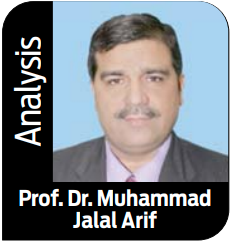
Former Professor & Head, Department of Entomology, University of Agriculture Faisalabad