Spokesman Report
ISLAMABAD: Minister for National Health Services, Regulations, and Coordination, Syed Mustafa Kamal while assuring the government’s full support to the pharmaceutical industry on Wednesday set an ambitious target of achieving $30 billion in pharmaceutical exports over the next five years.
Addressing at the 8th Pakistan Pharma Summit and the 4th Pharma Export Summit & Awards (PESA 2025) here, the minister emphasized the industry’s potential to become a game changer for Pakistan’s economy. “Although this is a challenging target, it is achievable with commitment and hard work,” said Kamal. “Let’s move forward and work round the clock to meet this target,” he remarked.
He highlighted that if other countries can generate $300 billion through pharmaceutical exports, Pakistan should also aim confidently for $30 billion.
While acknowledging the recent 35% growth in pharma exports over the past year, the minister said that the current figure of $ 475 million is not enough. “It’s a step forward, but not something to be satisfied with. We must think bigger,” he stated.
Kamal assured that the government is fully aware of its responsibilities and is taking concrete steps to remove bureaucratic hurdles. “What used to take months or years to approve is now being cleared within weeks. We are adopting digitization, and this is an opportunity we must seize to enhance our exports.”
He also revealed plans to transform Basic Health Units (BHUs through telemedicine, ensuring that healthcare services and medicines reach people at their doorsteps. As a pilot project, BHUs in Karachi and Islamabad are being upgraded to telemedicine facilities, aiming to reduce pressure on tertiary care hospitals.
Regarding local production of vaccines, Syed Mustafa Kamal said that currently 95 per cent vaccines are being imported, mostly from neighboring countries.
He urged the pharmaceutical sector to focus on local production of vaccines and essential medicines, to reduce dependency and build self-reliance.
“There is a dire and urgent need to develop indigenous capabilities for vaccine production. The pharmaceutical industry must step up to this challenge,” he said.
Earlier, speaking at the event, Chairman of the Pakistan Pharmaceutical Manufacturers Association (PPMA) Tauqeer ul Haq said that the pharmaceutical industry recorded a 35% growth over the past year, with total pharma exports reaching approximately $500 million per annum.
He said that the industry is eyed to further increase exports to Afghanistan, with a target of $500 million specifically for that market. However, he noted a major challenge that 90% of raw materials used for medicine manufacturing are currently being imported, while only 10% are locally available.
Tauqeer ul Haq appreciated Chief Executive Officer of the Drug Regulatory Authority of Pakistan (DRAP), Dr. Obaidullah, for his proactive support and facilitation of the pharma sector. “Previously, we faced significant hurdles in export processes. Now, export registrations are being granted within a week, which is a major step forward,” he said. “These reforms will help the industry grow and flourish.”
He expressed optimism about the future of Pakistan’s pharmaceutical sector, stating, “We are committed to producing high-quality medicines not just for the local population, but also for export to global markets.”
He said that the Pharma Industry can also produce vaccines if they are supported by the government.
The PPMA chairman urged the government to establish an independent trade body for the pharmaceutical industry, to be named PharmEx, which would focus on resolving industry issues and promoting exports.
He said the Ministry of Commerce has already submitted a summary to the Cabinet for the approval of the PharmEx body, and he called for its early approval.
Speaking on the occasion, former Chairman of the Pakistan Pharmaceutical Manufacturers Association (PPMA), Dr. Sheikh Kaiser Waheed, said that the pharmaceutical sector has witnessed significant growth in recent years. “We have the potential to achieve the ambitious target of $30 billion in pharma exports, but this will require full government support, including technology transfer, regulatory reforms, and the adoption of AI-based equipment,” he said.
He said that Pakistan’s pharmaceutical exports have already reached $475 million in a short span of time, reflecting the industry’s growing capacity and global competitiveness.
He said the Summit comes at a decisive moment for Pakistan’s pharmaceutical sector “While we already produce more than 90% of the country’s medicines domestically, the true test ahead is to compete globally on innovation, quality, and trust — not price alone,” he added.
Speaking on the occasion CEO DRAP Dr Obaidullah lauded the organizers of the summit and said that the world was changing and digitizing was a very important thing. He said that despite various challenges, the pharma industry in Pakistan was continuously growing and its exports witnessed an upward trend with passage of every year. DRAP was taking various transformation steps to make the country’s pharma industry compatible to the international standard and exposed to international auditing, he said.
He said DRAP was also ready to coordinate with the pharma industry in order to move it forward.
Jim Harris AI GenAI & Disruptive Innovation Expert gave a detailed presentation on artificial intelligence in drug discovery and manufacturing.
Dr Zakieh Al-Kurdi (USP, EMEA) spoke on regulatory policy while Prof. Khalid Ahmad Sheikh (UCL, UK) elaborated on building a culture of quality, and Geoff Tsen, PhD (USP, Greater China) on resilience and standards.
The Summit highlighted compliance with international benchmarks, such as WHO, PIC/S, and MHRA certifications, which are now seen as essential for Pakistan’s entry into advanced markets.
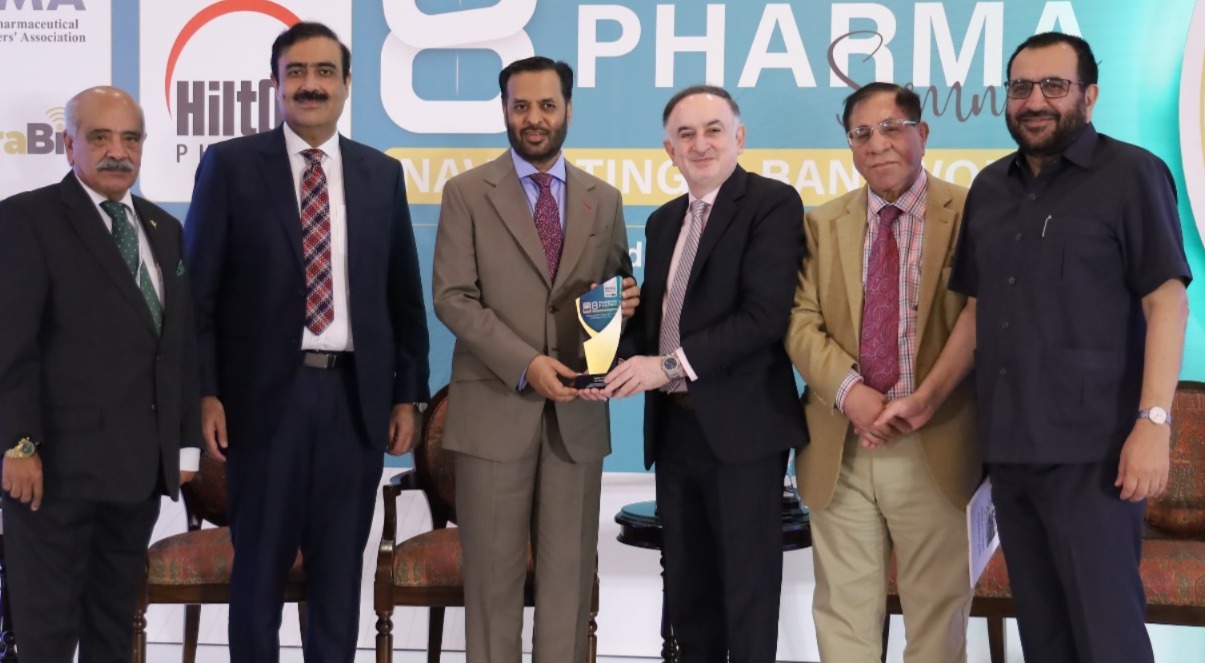
Later, the PESA 2025 Awards were distributed among the companies and individuals driving Pakistan’s pharma exports to recognize their outstanding performance in the field of pharma industry.