Pakistan’s economy to grow by 1.8 percent in fiscal year 2024: says World Bank

Spokesman Report
ISLAMABAD: Pakistan’s economy is expected to grow by only 1.8 percent in the current fiscal year ending June 2024. According to World Bank’s latest Pakistan Development Update: Fiscal Impact of Federal State-Owned Enterprises released today, this subdued recovery reflects tight monetary and fiscal policy, continued import management measures aimed at preserving scarce foreign reserves, and muted economic activity amid weak confidence. The Update also highlights the high fiscal costs of federal state-owned enterprises (SOEs) and the critical reforms needed to improve their performance, efficiency, and governance, including via privatizations.
After a contraction in FY23, economic activity has strengthened over the first half of FY24 on the back of strong agricultural output. This, together with improved confidence, also supported some recovery in other sectors. But growth remains insufficient to reduce poverty, with 40 percent of Pakistanis now living below the poverty line. Macroeconomic risks remain very high amid a large debt burden and limited foreign exchange reserves.
“The structural reforms needed to durably improve the economic outlook are known. Developing a clearly articulated reform implementation plan that is ambitious, credible and that shows quick progress is now essential to restore confidence,” said Najy Benhassine, World Bank Country Director for Pakistan. “In particular, better fiscal management will help to lower inflation, narrow the current account deficit, improve financial sector stability and increase credit to the private sector, all of which are critical for robust economic recovery.”
A sustained medium-term recovery will require a prudent macroeconomic policy mix coupled with reforms to improve the quality of expenditures, broaden the tax base, address regulatory constraints to private sector activity, reduce state presence in the economy—including via privatizations, address challenges in the energy sector, and increase public investments to improve human development outcomes.
The Update includes a list of key reforms in ten areas that should be considered for priority implementation to initiate a strong, durable and poverty-reducing economic growth recovery.
“The current macroeconomic outlook projects growth that is below Pakistan’s potential, with little poverty reduction and continued erosion of living standards,” said Sayed Murtaza Muzaffari, lead author of the report. “Risks to this outlook remain high, including uncertainty around policy commitments and reform implementation, financial sector risks, potential increases in world energy and food prices in the context of intensification of regional geopolitical conflicts, slower global growth, and tighter than expected global financing conditions.”
 The update highlights the high fiscal costs of SOEs operating in key sectors of the economy. These SOEs have been consistently making losses since 2016, and the government has been providing significant financial support through subsidies, grants, loans, and guarantees, leading to large and growing fiscal exposure.
“Direct government support to SOEs in the form of subsidies, loans, and equity investments accounted for 18 percent of the federal budget deficit and 2 percent of GDP in FY22,” said Qurat Ul Ain Hadi, co-author of the report.
To contain fiscal exposure from SOEs, the report recommends rapid progress with government plans for privatization, restructuring, and divestment—per the 2021 Triage plan. In addition, the update recommends establishing new guarantee issuance rules, mitigating credit risks, ensuring adherence to International Financial Reporting Standards and developing risk monitoring procedures. All SOEs, including those under the SWF, should be covered under the purview of the SOE Act to ensure financial transparency and good corporate governance practices.
The Pakistan Development Update is a companion piece to the South Asia Development Update, a twice-a-year World Bank report that examines economic developments and prospects in the South Asia region and analyzes policy challenges countries face. The April 2024 edition titled Jobs for Resilience shows growth in South Asia is again higher than any other developing country region in the world at 6 percent in 2024, but that persistent structural challenges threaten to undermine sustained growth. This is hindering the region’s ability to create jobs and respond to climate shocks. The report explores pathways countries can take to sustain long-term growth and reduce climate risks by boosting employment and increasing private investment.

Related Posts

Transparency International Delegation meets Chairman NAB

Spokesman Report Islamabad: A four members delegation of Transparency International (TI), led by its Chair Mr. François Valérian, met Chairman National Accountability Bureau (NAB) Lt. Gen. (R) Nazir Ahmed at NAB…

𝗣𝗮𝗸𝗶𝘀𝘁𝗮𝗻 𝗥𝗮𝗶𝗹𝘄𝗮𝘆𝘀, 𝗡𝗟𝗖 𝗲𝘅𝗽𝗹𝗼𝗿𝗲 𝗮𝘃𝗲𝗻𝘂𝗲𝘀 𝗼𝗳 𝗺𝘂𝘁𝘂𝗮𝗹 𝗰𝗼𝗼𝗽𝗲𝗿𝗮𝘁𝗶𝗼𝗻

Spokesman Report Islamabad: The Minister for Railways, Mr. Muhammad Hanif Abbasi visited Headquarters National Logistics Corporation (NLC) and held an in-depth interaction with senior management of NLC focusing on expansion…


You Missed

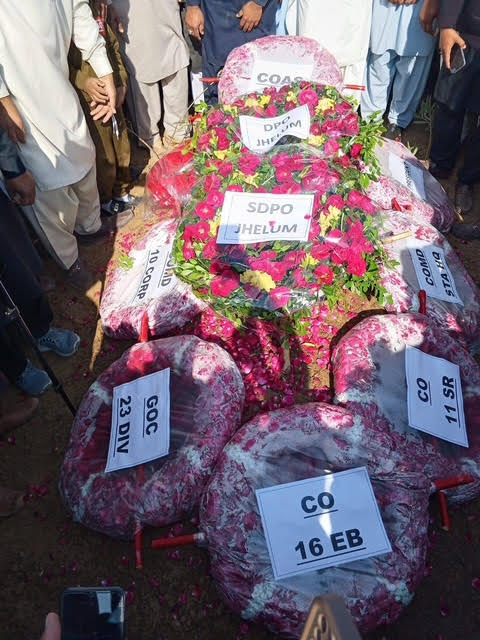
AJK President Barrister Sultan Mehmood Chaudhry passes away

AJK President Barrister Sultan Mehmood Chaudhry passes away

TMUC Gets Glorified with Launch of Gloria Jean’s Café at Islamabad

TMUC Gets Glorified with Launch of Gloria Jean’s Café at Islamabad

Daily The Spokesman 31 January 2026 PDF

Daily The Spokesman 31 January 2026 PDF

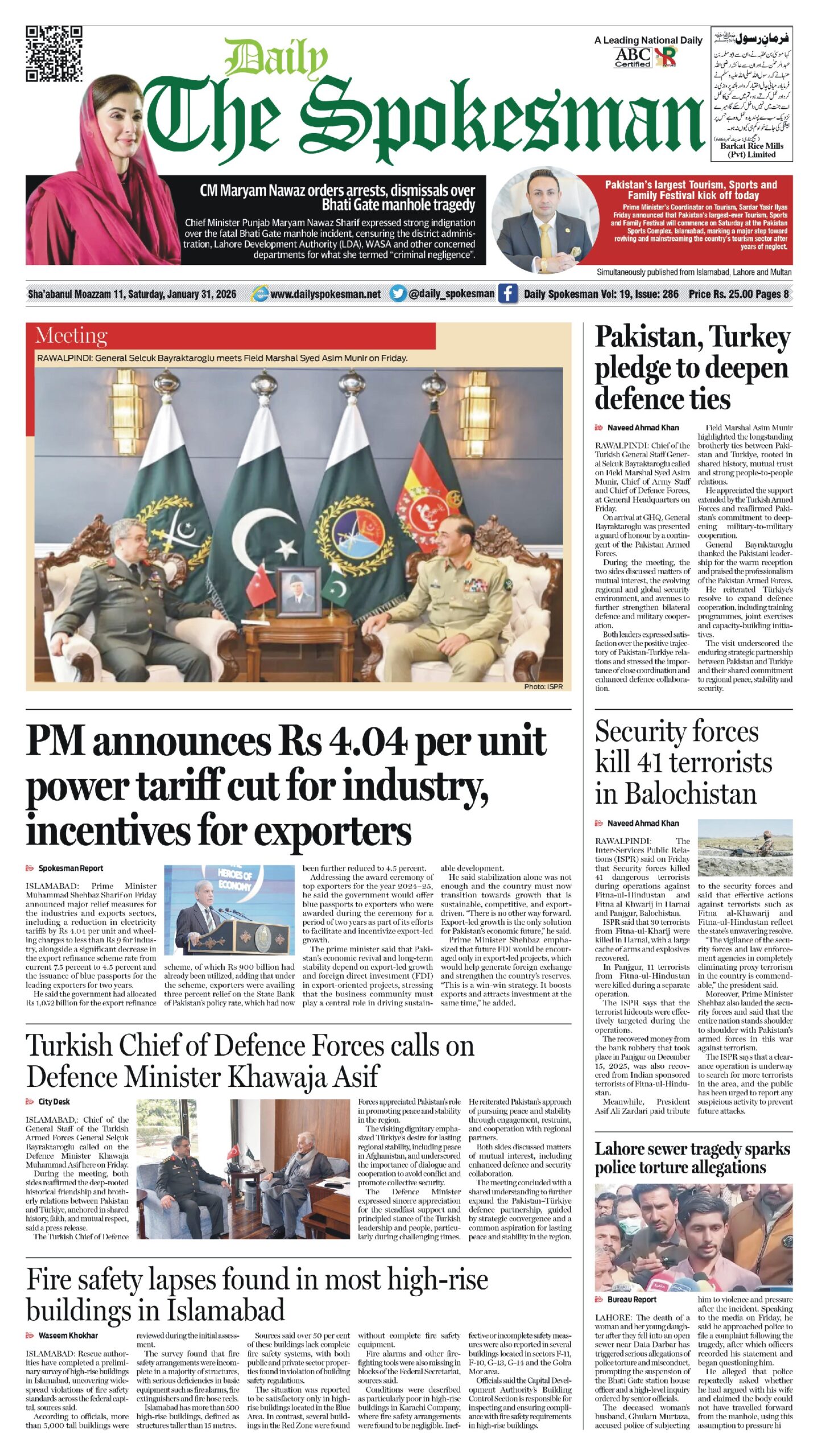
Nation Mourns as Martyred Pakistani Soldier Laid to Rest with Full Military Honours

Nation Mourns as Martyred Pakistani Soldier Laid to Rest with Full Military Honours

Pakistan, Turkey pledge to deepen defence ties

Pakistan, Turkey pledge to deepen defence ties

Influence of Social Media: Redefining Power in the Digital Age

Influence of Social Media: Redefining Power in the Digital Age