Home Blog Page 7

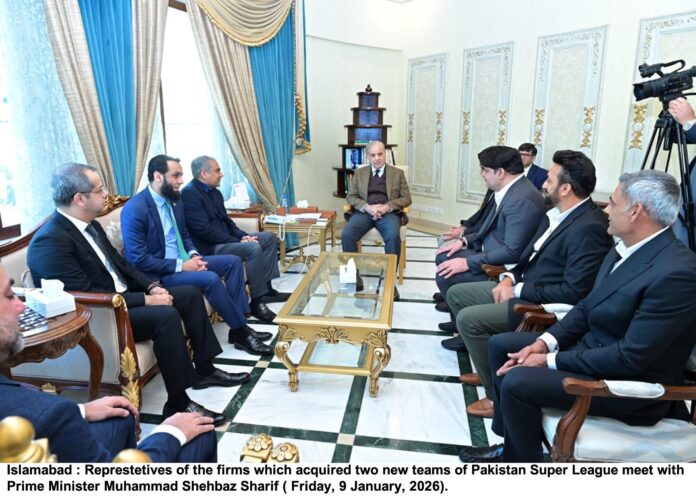
 Int’l firms’ participation in PSL teams’ auction to promote foreign investment in country: PM

0

City Desk

ISLAMABAD:Prime Minister Muhammad Shehbaz Sharif on Friday welcomed the participation of international firms in the auction for the two new franchises of the Pakistan Super League (PSL), stating that it would help promote foreign investment in the country.

He said overseas Pakistanis were playing a critical role in the nation’s development.

The prime minister was speaking to representatives of the two firms that won the franchise bids. Hamza Majeed of the OZ Developers and Fawad Sarwar of the Southeast Asian holding company FKS attended the meeting.

He extended congratulations to the representatives of the Sialkot and Hyderabad teams and conveyed his best wishes for their future.

The prime minister also congratulated Chairman of the Pakistan Cricket Board, Mohsin Raza Naqvi, and his team for ensuring a successful and transparent auction.

“The entire auction process for the new PSL teams was broadcast live on television, which reflects transparency,” the prime minister remarked, adding that the new teams would prove to be a breath of fresh air.

He noted that the active participation of national and international firms in the bidding demonstrated the PSL’s growing popularity at the global level.

The meeting was also attended by Interior Minister Mohsin Naqvi and Information Minister Attaullah Tarar.

Police Performance in Multan: The Widening Gap Between Claims and Reality

0

The widening gulf between the claims of Multan police and the bitter realities faced by citizens is no longer a mere administrative lapse; it has become a moment of serious reflection for our collective conscience. Amid the dazzle of social media posts and the echo of press conferences, tales of alleged recoveries worth millions are narrated as if crime has been eradicated from the city. On the ground, however, reality bluntly contradicts this narrative.

The ordinary citizen continues to lose motorcycles, cash and valuables, standing at police station doors with little more than hope for justice. Fahim Hasan Bhatti, personal assistant to Malik Muhammad Akmal Wains Editor  Roznama Badalta Zamana Multan and CEO of Mux News — was robbed of Rs100,000 in cash and a mobile phone outside his home. FIR No 2218/25 was registered at New Multan police station, yet recovery remains zero. Computer engineer Muhammad Ashan Rohani was deprived of his mobile phone and motorcycle within the jurisdiction of BZ police station, with the same outcome: no recovery. My class fellow, Dr Javeed Akhtar, had his motorcycle stolen from outside Nishtar Hospital hostel; FIR No 391/21 was registered at Chehlik police station, but years later the file remains frozen where hope goes to die.

Similarly, Muhammad Aftab, an employee of SM Food Factory, lost his Honda 125 motorcycle in Old Kotwali’s area. Despite approaching SP  Saif ullah Gujjar Gulgasht and filing complaints on 1787 and the Pakistan Citizen Portal, and FIR No 884/24 being registered, the result remains unchanged. Zafar Iqbal’s case (FIR No 833/25, Shah Shams police station) tells the same story — the recovery column still blank.

IG Punjab, these are only a handful of cases  all involving our close friends and employees. Beyond these lie countless untold stories scattered across every street of this city, unheard and unattended. The question is not why FIRs are registered. The real question is: to whom are recoveries actually handed over? Whose losses are compensated, and who is left holding nothing but receipts and hollow assurances? On this distinction, the police have never issued a clear or transparent explanation.

As long as performance is measured through press releases and publicity, and the redress of a citizen’s loss is reduced to the mere entry “FIR registered”, recoveries worth millions will remain paper victories. True success will come the day the common man gets back his stolen motorcycle, looted cash and, most importantly, his lost trust. Until then, questions will persist and silence itself will stand as a grave answer.

The contrast between truth and the image projected on social media has become the core reason for the erosion of public trust in the police. On one side, drums are beaten over the recovery of cars, tractors and motorcycles, with success stories piled high and performance portrayed as exemplary. On the other, the ground reality is that these recoveries benefit only a select few, while deprivation remains the lot of the ordinary citizen.

On a daily basis, a large number of cases are consigned to files under the pretext of “no clue”. On paper, the case is closed; in reality, the victim’s wounds remain fresh. The question is not whether the police are taking action, but for whom these actions are taken. Is the rule of law equal for all, or has justice itself become dependent on influence and connections?

Another alarming aspect is the conduct witnessed in Multan police’s khuli katcheries. Instead of acting as representatives of the public, some journalists appear as recommenders. The police oblige them, files begin to move, and what is impossible for an ordinary citizen becomes achievable within moments. This practice not only undermines the very concept of justice but further weakens the police’s public credibility.

This situation raises a fundamental question: have the institutions responsible for protecting citizens’ lives and property failed, or are they functioning only for a chosen few? Until this question is answered honestly and practically, social media glamour will not be able to rebuild public trust. Trust is not born of advertisements or press releases; it emerges from equal access to justice — and that is the yardstick by which police performance is being judged today.

A silent yet extremely damaging practice within senior police offices, particularly SP offices, has hollowed out public trust from within. Complaints lodged through the Pakistan Citizen Portal or police helpline 1787 filed with the hope that at least higher authorities will listen — are often “dropped” with misleading, vague and factually contradictory comments. This is not the discretion of a station house officer; it is a process carried out at the SP office level, where a single stroke of the pen shuts the door on a citizen’s plea for justice.

This is not mere administrative apathy; it is a mockery of state trust. When complainants are told that “action has been completed” or that “the complainant is satisfied”, while in reality no recovery has taken place and no meaningful contact has been made, one must ask: who are these reports meant to satisfy — the public or the higher-ups?

This disparity — between glowing performance claims on social media and the silent burial of complaints in offices — is inflicting irreparable damage on the police’s credibility, not just in Multan but across the province. When citizens see their complaints vanish into the system, they lose faith not only in the police but in state institutions as a whole.

Direct intervention by the IG Punjab Police has now become unavoidable. The entire mechanism needs to be reviewed afresh to end the practice of “disposing” complaints under the guise of resolution, and to ensure that the people of Multan get back their valuable property — motorcycles, vehicles, cash — and their trust.

Steps to restore trust include:

Independent audit system: Quarterly independent audits of decisions taken on complaints filed via the Citizen Portal and 1787 to determine on what basis cases were dropped.

Mandatory written justification: SP offices must provide detailed, written and evidence-based reasons before dropping any complaint — visible to the complainant as well.

Complainant verification: No case should be marked “satisfied” without written or digital confirmation from the complainant; internal notes should not suffice.

Recovery tracking dashboard: A public dashboard in every district showing FIR numbers, nature of crime and recovery progress to expose the gap between claims and reality.

Officer accountability: Where it is proven that misleading comments were deliberately used to drop complaints, exemplary departmental action must follow.

Reforming khuli katcheries: These forums should serve public accountability, not recommendations, with decisions formally recorded and compliance reports issued.

If the true purpose of policing is the protection of citizens’ lives and property, then the police must move beyond promotional narratives to deliver practical justice. Otherwise, every complaint quietly marked “dropped” will continue to widen the distance between the police and the public — a distance no press conference can ever bridge.
Dark Legacy: A Chronicle of Kashmir’s Tragedies

0

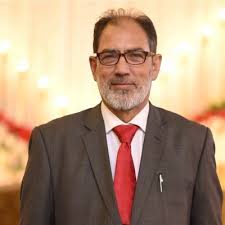
Altaf Hussain Wani

In the annals of Indian-occupied Jammu & Kashmir, January emerges as a period of deep anguish and solemn commemoration. This month serves as a stark reminder of a protracted conflict that has ravaged the region for decades, marked by systematic bloodshed, punitive collective actions, and lingering injustices. From the onset of the 1990s insurgency to recent times, January has repeatedly borne witness to horrific mass killings and egregious rights violations by state and non-state entities alike. These events have seared themselves into Kashmiri consciousness, amplifying demands for accountability, justice, and a definitive break from perpetual violence.

Sopore’s Day of Infamy (6 January 1993)

Northern Kashmir’s town of Sopore endured unimaginable horror on 6 January 1993 when Border Security Force (BSF) troops unleashed gunfire on unarmed residents, claiming at least 57 lives. The assault extended beyond bullets—security forces torched the commercial heart of the town, reducing livelihoods to ashes and displacing hundreds. Eyewitnesses describe how BSF members fired without discrimination at ordinary citizens, including minors and women, before systematically incinerating homes and businesses. The Sopore incident epitomizes collective retribution, where an entire populace suffered for suspected militant actions.

Wandhama’s Night of Terror (25 January 1998)

January 25, 1998, the village of Wandhama in Ganderbal district witnessed a horrific  massacre, in which 23 Kashmiri Pandits were systematically killed. The attack, carried out by assailants were identified in military uniform, brutally targeted members of a community that had, in the early 1990s, refused to associate itself with a state-managed exodus from the valley. . While Indian  agencies attributed the massacre to armed  groups, to identify the inicident as communal and sectarian one, but the incident raised profound questions about the state’s capacity and commitment to protecting all its citizens.

Kupwara’s Protest Bloodbath (27 January 1994)

On 27 January 1994, Kupwara witnessed state violence at its deadliest when army units fired upon demonstrators opposing a local youth’s detention. The indiscriminate shooting cut down 27 civilians, many of them women and children. The Kupwara killings illustrate the security apparatus’s tendency toward disproportionate responses to civil dissent, resulting in catastrophic civilian casualties.

Handwara’s Two-Day Carnage (25–26 January 1990)

The twin days of 25–26 January 1990 marked Handwara as a killing field where over 50 civilians perished in a security forces’ onslaught. This massacre formed part of a wider wave of state-led violence during the insurgency’s formative phase, when authorities attempted to crush the emerging resistance through overwhelming force.

Gawkadal’s Bridge of Death (20 January 1990)

Srinagar’s Gawkadal locality became synonymous with state brutality on 20 January 1990 after CRPF personnel gunned down at least 52 protesters. The demonstration was among many challenging New Delhi’s Kashmir policies. Frequently cited as the conflict’s most devastating single massacre, Gawkadal symbolizes the ruthless suppression of peaceful civilian opposition.

Bijbehara’s Shrine Siege Aftermath (22 January 1994)

Two days after the Kupwara killings, Bijbehara suffered its own tragedy on 22 January 1994 when BSF forces shot dead 51 demonstrators. The protesters had gathered against the military cordon of Srinagar’s Hazratbal shrine. The Bijbehara massacre further demonstrated security forces’ pattern of lethal overreaction to unarmed civil protests.

Systematic Brutality and Collective Retaliation

These January atrocities form part of a systematic pattern rather than isolated tragedies. Security forces have frequently answered minor incidents with mass civilian killings, arson, and property demolition. The torching of entire settlements, as seen in Sopore, and the targeting of minority groups, as in Wandhama, reveal brutal counterinsurgency tactics. Peaceful demonstrations have consistently ended in mass deaths, evidenced by Gawkadal and Bijbehara, showing a disturbing disregard for unarmed civilian life and a persistent absence of consequence for perpetrators.

Enduring Impunity and Rights Abuses

Perhaps most disturbing is the entrenched culture of impunity surrounding these crimes. Those responsible for ordering and executing these massacres have almost never faced prosecution. This immunity has enabled widespread enforced disappearances, systematic torture, and staged gunfights, with thousands still unaccounted for. The unearthing of mass burial sites across multiple districts underscores the magnitude of atrocities. New Delhi has consistently rejected these documented abuses as “fabricated propaganda,” widening the chasm of distrust between Kashmiris and the Indian establishment.

Global Condemnation and Diplomatic Inaction

International bodies have repeatedly voiced alarm over Kashmir’s human rights crisis. The United Nations and Amnesty International have issued numerous condemnations and demands for accountability. Yet these appeals have largely been ignored, with India maintaining its stance of denial and rejecting external oversight.

Unhealed Wounds and the Road to Justice

The January massacres stand as enduring symbols of Kashmir’s unresolved trauma, where militarization continues to punish civilian populations. The cry for justice and truth remains unanswered, keeping historical wounds festering. As Kashmiris annually mourn these tragedies, global conscience cannot afford to look away. Sustainable peace demands truth-telling, judicial accountability, and definitive cessation of violence.

The narratives of Sopore, Wandhama, Kupwara, Handwara, Gawkadal, and Bijbehara must be preserved in historical memory. They testify to Kashmiri resilience while urging the international community to align with their quest for justice and human dignity.

Writer is chairman Kashmir institute of international Relations and can be reached at :   [email protected] and [email protected]

Trump Signals a New Global Posture

0

Venezuela, Cuba, Mexico and Greenland at the Center of a Hard-Line Future Strategy

Washington, D.C. — In a series of closely watched remarks over the past 48 hours, Donald Trump has once again placed American power, leverage, and strategic dominance at the heart of his foreign-policy narrative, outlining a future approach that sharply focuses on Venezuela, Cuba, Mexico, and Greenland.

Though no formal executive actions have yet been announced, Trump’s language has sent diplomatic ripples across Latin America, Europe, and the Arctic region, raising questions about how far the United States may be prepared to go in redefining its role in the Western Hemisphere and beyond A Message of Power and Positioning

Speaking in broad but unmistakably forceful terms, Trump framed these regions as central to America’s national security, economic interests, and geopolitical competition. His remarks emphasized that U.S. policy moving forward would be driven by outcomes rather than process, signaling impatience with long-standing diplomatic stalemates.

Observers noted that the tone marked a continuation — and intensification — of Trump’s earlier worldview: alliances are transactional, sovereignty is respected conditionally, and American influence must be visible, measurable, and enforceable.

Venezuela: Pressure Without Apology

Venezuela emerged as the most urgent focal point. Trump portrayed the country as a symbol of failed governance, economic collapse, and regional instability. He suggested that future U.S. engagement would hinge on strict conditions tied to political reform, energy interests, and accountability.

While stopping short of announcing sanctions or interventions, the rhetoric implied that Washington sees Venezuela not only as a humanitarian concern but as a strategic challenge with consequences for regional security and global energy markets.

Diplomats across Latin America reacted cautiously, warning that heightened pressure could destabilize an already fragile region, while others acknowledged that Venezuela’s crisis remains unresolved after years of international efforts.

Cuba: No Concessions Without Change

Trump’s comments on Cuba reflected a familiar skepticism toward engagement without reform. He reiterated that normalization cannot occur in the absence of demonstrable improvements in civil liberties and political freedoms.

By linking Cuba’s future to broader regional dynamics, Trump signaled that the island nation’s long-standing isolation may again become a tool of leverage rather than reconciliation. Analysts note that such a stance appeals to domestic political constituencies while placing Havana under renewed international scrutiny.

Mexico: Partnership Under Pressure

Mexico occupied a delicate position in Trump’s remarks — described simultaneously as a vital partner and a source of unresolved challenges. Border security, migration, and organized crime were cited as ongoing concerns, while trade cooperation was framed as essential but conditional.

Mexican officials responded by emphasizing sovereignty and mutual respect, reiterating that cooperation must remain bilateral and lawful. Despite the tough rhetoric, experts believe that behind-the-scenes coordination on trade and security is likely to continue, even as public messaging remains tense.

Greenland: The Arctic Enters the Spotlight

Perhaps the most unexpected element of Trump’s statements involved Greenland. By highlighting the territory’s strategic location, natural resources, and Arctic relevance, Trump revived global debate over the future of the region amid rising interest from major powers.

Denmark and Greenlandic leaders swiftly reaffirmed that Greenland’s future is determined by its people, not external ambitions. Still, Trump’s remarks underscore growing U.S. concern over Arctic militarization, climate-driven access to resources, and competition with rival powers.

International Reaction and Strategic Implications

Across global capitals, reactions ranged from concern to cautious interpretation. European allies stressed the importance of diplomacy and international law, while Latin American leaders warned against policies that could revive Cold War–era tensions.

Security analysts argue that Trump’s statements are best understood as strategic signaling — designed to shift negotiating positions before concrete policy moves are made. Others warn that rhetoric alone can reshape markets, alliances, and regional stability.

What Comes Next

In the short term, officials expect intensified diplomatic engagement rather than immediate action. Key indicators will include:

  • Changes to sanctions frameworks
  • Shifts in trade or border policy
  • Increased U.S. activity in the Arctic
  • Expanded diplomatic pressure on regional governments

In the longer term, Trump’s message suggests a world in which American foreign policy is unapologetically interest-driven, less restrained by multilateral norms, and increasingly shaped by strategic competition.

A Defining Moment

Whether these remarks mark the beginning of a new phase in U.S. global engagement or remain a forceful preview of intentions, they have already succeeded in resetting the conversation. For allies and adversaries alike, the message is clear: under Trump’s vision, geography, power, and leverage once again define America’s place in the world.

Trump’s War on the World Order: Burying the United Nations and NATO

0

In his first term, Donald Trump unsettled the international system but did not fully dismantle it. Bureaucratic inertia, judicial limits, and allied resistance acted as brakes. In his second term, those restraints have largely disappeared. What is unfolding now is not simply an assertive foreign policy, but a systematic effort to dismantle the post–World War II international order—an order built around the United Nations, collective security, multilateral problem-solving, and the idea that power must be tempered by rules.

That intent became unmistakable on January 7, 2026, when President Trump signed a Presidential Memorandum directing the United States to withdraw from 66 international organizations deemed no longer aligned with American interests. The order instructed all executive departments and agencies to cease participation in and funding for 35 non-UN bodies and 31 UN entities. This sweeping decision followed a government-wide review of every international organization, treaty, and convention in which the United States holds membership or provides financial support. The stated rationale was blunt: these institutions were judged to operate against U.S. national interests, sovereignty, economic prosperity, or security, or to function so inefficiently that American taxpayer dollars were “better allocated elsewhere.”

The administration framed the move as an act of reclamation—“restoring American sovereignty.” Officials argued that many of the targeted organizations promote what they describe as globalist governance, radical climate policies, and ideological agendas incompatible with U.S. priorities. Billions of dollars, they contended, had been spent on bodies that routinely criticize U.S. policy, dilute American influence through one-nation-one-vote structures, or fail to deliver measurable results. Withdrawal, in this view, was not isolationism but efficiency: cutting costs, ending constraints, and redirecting resources toward “America First” objectives.

This memorandum did not emerge in isolation. Immediately upon returning to office, President Trump renewed the U.S. withdrawal from the World Health Organization and the Paris Climate Agreement. On his first day, he also notified the Organization for Economic Co-operation and Development that its Global Tax Deal would have “no force or effect” in the United States, while ordering an investigation into whether foreign tax regimes unfairly target American companies. Weeks later, he signed an executive order withdrawing from the UN Human Rights Council and permanently prohibiting U.S. funding for the UN Relief and Works Agency for the Near East. The January 7 memorandum consolidated these actions into a single doctrine: disengage, defund, and dismantle multilateral constraints.

That institutional retreat has been paired with a dramatic expansion of hard power. The U.S. defense budget for 2026 stands at approximately US$901 billion, already the largest in the world by a wide margin. President Trump has now proposed raising military spending to US$1.5 trillion in 2027, citing “troubled and dangerous times.” This figure would exceed the combined defense spending of the next several major powers. By comparison, the entire European continent—including all NATO members except the United States—collectively spends roughly US$300–350 billion annually, lacks unified command, and depends heavily on U.S. strategic enablers. The gap underscores a shift from deterrence to dominance.

That dominance was displayed on January 3, 2026, when U.S. forces carried out a sudden military operation in Venezuela, capturing President Nicolás Maduro and transferring him to the United States to face federal drug-trafficking charges. U.S. naval and air assets surged in the Caribbean, while Venezuelan oil exports were effectively sealed off under intensified enforcement. Regardless of legal justifications, the geopolitical meaning was stark: a sitting head of state was removed by force. The precedent shattered long-standing norms of sovereignty and reinforced the administration’s belief that power, not process, is the ultimate arbiter.

From the Caribbean, the strategic focus turns northward—to the Arctic and Greenland. Greenland has moved to the center of U.S. attention because climate change is rapidly transforming the region. As Arctic ice melts, new sea routes are emerging that could shorten Asia–Europe shipping distances by up to 40 percent. Analysts estimate that a fully viable trans-Arctic corridor could eventually carry trade worth hundreds of billions of dollars annually, reducing reliance on chokepoints like the Suez Canal and reshaping global commerce.

Greenland also holds significant mineral potential. The island contains deposits of rare earth elements, zinc, iron ore, uranium, neodymium, dysprosium, cerium, gallium and other critical minerals essential for advanced electronics, defense systems, and energy technologies. The strategic value lies in future access combined with geography. Greenland sits astride the North Atlantic and Arctic approaches, offering proximity to Russia’s northern flank and growing Chinese polar interests.

Demographically and politically, Greenland is small but democratic. Its population of roughly 56,000, overwhelmingly Inuit, governs itself through an elected parliament under a system of extensive autonomy within the Kingdom of Denmark. What Greenland lacks is military capability. That asymmetry fuels the dangerous assumption that control could be asserted without resistance—a notion that sends shockwaves through Europe.

For European allies, particularly Denmark, this is a profound betrayal. Denmark was among NATO’s most committed contributors in Afghanistan, suffering one of the highest per-capita casualty rates. For decades, Europe accepted reduced military autonomy in exchange for American protection. Now, the prospect that territorial threat could originate from the alliance’s dominant power has forced a strategic reckoning. Only France and the United Kingdom retain full-spectrum capabilities, including nuclear deterrence. The rest are scrambling to rebuild defenses hollowed out by dependence.

This strikes at the heart of NATO. An alliance cannot survive when its strongest member behaves as a territorial revisionist. If the United States were to assert control over Greenland, NATO would not collapse under external attack; it would die of internal contradiction. In such a scenario, the strategic logic underpinning the war between Ukraine and Russia would also change. A hollowed-out NATO would no longer represent a coherent expansion threat to Russia, eroding the rationale that has sustained confrontation with Ukraine.

What emerges is a world in accelerated realignment. Europe is reconsidering dependence, Latin America braces for renewed interventionism, and Asia prepares for maritime and economic confrontation. With the United Nations weakened and multilateral forums abandoned, disputes that once might have been mediated now drift toward unilateral force.

These are perilous times. The January 7 withdrawal from 66 international organizations marks not a tactical adjustment, but a strategic severing from the architecture that once stabilized global politics. Power is being centralized, institutions dismantled, and restraint discarded. History suggests that such moments rarely end quietly. The choice before the world is stark: rebuild collective order—or prepare for an era in which power alone decides, and the world order is not merely weakened, but buried.

The writer is Press Secretary to the President (Rtd),Former Press Minister, Embassy of Pakistan to France,Former Press Attaché to Malaysia and Former MD, SRBC.He is living in Macomb, Michigan, USA

Legendary Pakistani Cricketer Shahid Khan Afridi visits TMUC, Islamabad

0

Spokesman Report

Islamabad, Thursday January 08, 2026: TMUC Higher Education Group and Champions Hub formalised a landmark partnership through the signing of a Memorandum of Understanding (MOU) at TMUC Islamabad, aimed at empowering youth, fostering excellence, and creating meaningful opportunities for the leaders of tomorrow says a press release.

The ceremony was graced by the presence of Legendary Pakistani cricketer and global sports icon, Shahid Khan Afridi, and Mr Aamir Chottani, entrepreneur and co-founder of Alliance Sports Ventures (ASV), whose visit generated great enthusiasm among TMUC students. The campus witnessed an atmosphere of excitement and inspiration as students had the opportunity to meet, interact with, and learn from two prominent figures shaping Pakistan’s sports and business landscape.

Welcoming the Champions Hub leadership, Dr. Faisal Mushtaq TI, Founder and CEO of TMUC Higher Education Group, warmly received Mr. Shahid Afridi and Mr. Aamir Chottani and delivered an address to the students, emphasising the importance of discipline, leadership, and holistic development alongside academic excellence. Dr. Faisal Mushtaq highlighted the value of industry-academia partnerships in preparing students for future careers and encouraged them to actively pursue opportunities that combine education, innovation, and sports.

The MOU represents a strategic collaboration focused on strengthening Pakistan’s sports and youth development ecosystem by creating meaningful linkages between education, professional growth, and athletic excellence.

Champions Hub operates under Alliance Sports Ventures (ASV), a pioneering sports infrastructure and development company established in 2024, committed to transforming the sports landscape across Pakistan. With a strong focus on elite facilities, youth development, and talent nurturing, ASV is redefining how modern sports and lifestyle destinations are envisioned, developed, and experienced across the nation.

Founded by internationally renowned sports icon Mr. Shahid Afridi and seasoned entrepreneur Mr. Aamir Chottani, ASV combines exceptional brand equity, industry credibility, and operational expertise to develop scalable, high-impact sports ventures across the country.

ASV’s flagship project, the Champions Hub Sports Arena, developed in strategic partnership with DHA Peshawar, stands as the first and only premium multi-sports facility in Peshawar. The fully operational arena currently offers cricket facilities, futsal courts, and padel tennis courts, while a dedicated sports café, The Hub Café, is under establishment.

As part of its Phase Two expansion, a state-of-the-art swimming pool and gymnasium are currently under construction and are scheduled for completion by March 2026, further strengthening Champions Hub’s position as a comprehensive sports and wellness destination.

Through this partnership, TMUC and Champions Hub aim to launch joint initiatives, including student internships, sports management exposure, leadership development programs, wellness activities, and community engagement projects. These initiatives will provide TMUC students with real-world learning opportunities and professional pathways within Pakistan’s growing sports and wellness sector.

Representatives from both institutions reaffirmed their shared commitment to nation-building through education, sports, and innovation, noting that this collaboration will contribute significantly to developing confident, capable, and socially responsible future leaders.

The TMUC x Champions Hub partnership reflects a forward-looking vision of integrating education with physical development, entrepreneurship, and leadership, supporting a stronger and more dynamic future for Pakistan’s youth.

China-US Reset Dominates Discussion at CASS Lahore Security Forum

0

Spokesman Report

Lahore:The Centre for Aerospace and Security Studies (CASS) Lahore organised a guest lecture titled “Evolving Global Order: China-US Reset” on 7 January 2026. As an independent think tank, CASS Lahore organises academic events for scholars and practitioners interested in national security in its wider context. The event was attended by academics, intellectuals, and domain experts.
Dr Ahsan Abbas, Director, CASS Lahore, delivered the opening address, noting that the evolving global order requires a renewed approach to balance competition and cooperation between major powers to ensure international stability.
Mr Shahid Javed Burki, an eminent economist and former finance minister, stated that the global order is undergoing a fundamental transformation as China’s rapid economic growth positions it to challenge the US, reflecting a significant realignment of global power. He highlighted China’s successful state-led development model and robust investment in technology in contrast to the market-driven approach and coercive power utilised by the United States to protect its strategic dominance. Furthermore, he noted that Pakistan occupies a critical role in China’s strategic calculus and underscored the importance of maintaining a stable and confident partnership while resisting external pressures and media propaganda that could undermine long-term economic cooperation.
In his concluding remarks, Air Marshal Asim Suleiman (Retd), President, CASS, Lahore, highlighted that the China-US relationship is the decisive factor reshaping the strategic, economic, and institutional contours of the twenty-first century. He observed that while strategic rivalry is structural and enduring, cooperation in areas of shared interest remains a practical necessity for global stability. He further noted that technology competition has emerged as a central fault line, requiring a balance between legitimate security concerns and the benefits of economic efficiency to avoid fragmenting the global economy.
The event concluded with a lively interactive session. The discussion explored Pakistan’s balancing policy between China and the United States, the prospects of CPEC 2.0, and the strategic positioning of regional actors amidst great power competition. The participants appreciated CASS Lahore’s initiative in hosting an engaging and thought-provoking discussion.

Field Marshal Munir Stresses Zero Tolerance for Security Threats During Lahore Visit

0

Spokesman Report

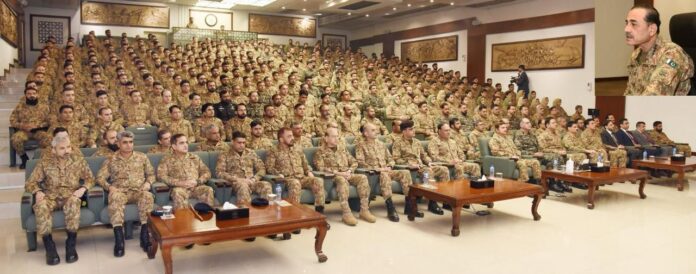
Rawalpindi, 8 January, 2026:Field Marshal Syed Asim Munir, NI (M), HJ, COAS & CDF, visited Lahore Garrison, where he was given a comprehensive briefing on the formation’s operational preparedness, training standards and key initiatives to enhance combat efficiency.

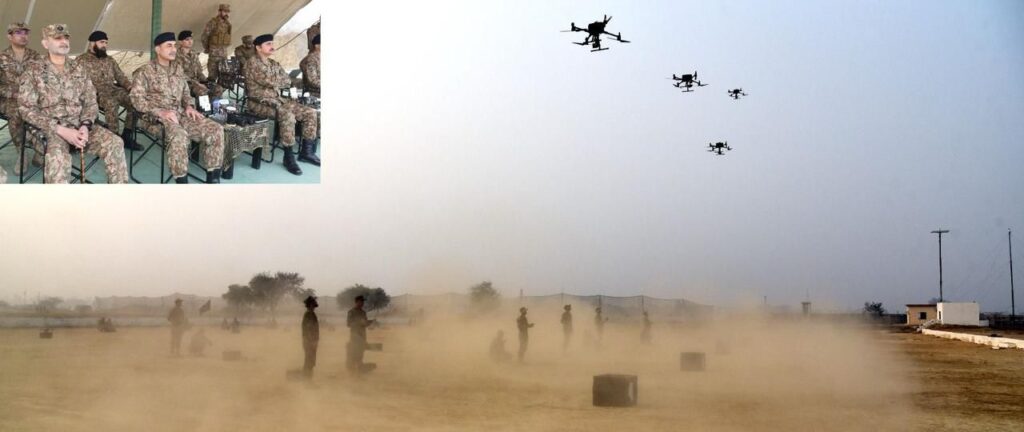
The COAS & CDF witnessed a specialized field training exercise showcasing the latest technologies, underscoring the Army’s emphasis on innovation, adaptability to match the dynamic future battlefield. He also inspected sports and recreational facilities being provided to troops, highlighting their importance in maintaining physical fitness, morale, and overall well-being.

Field Marshal Munir Stresses Zero Tolerance for Security Threats During Lahore VisitThe COAS& CDF also visited a High Care Center at CMH Lahore, lauding the efforts of the medical staff and administration in establishing a fully equipped, state-of-the-art healthcare facility.

During his address with the officers, the COAS & CDF emphasized upon Pakistan Army’s zero-tolerance policy towards any threat to national security, reaffirming the institution’s unwavering resolve to confront multifaceted challenges with focus, professionalism and determination. Reiterating Army’s core mission, he noted that the Pakistan Armed Forces remain steadfast in safeguarding the country’s sovereignty, territorial integrity and internal stability, while fostering a culture of excellence, discipline, and selfless national service.

Earlier, upon his arrival at Lahore Garrison, the COAS & CDF was received by Commander Lahore Corps.