Spokesman Report
1 December 2025, Islamabad, Pakistan – On the occasion of World AIDS Day, the World Health Organization (WHO) and UNAIDS are calling for action to reverse a trend that has made Pakistan home to one of the fastest-growing human immunodeficiency virus (HIV) epidemics in the WHO Eastern Mediterranean Region, with new infections rising by 200% over the last 15 years – from 16,000 in 2010 to 48,000 in 2024.
While HIV predominantly affected high-risk groups in the past, it is now spreading to children, spouses and the wider community due to unsafe blood management and injection practices, gaps in infection prevention and control, a lack of HIV testing during antenatal care, unprotected sexual activity, stigma and limited access to HIV services.
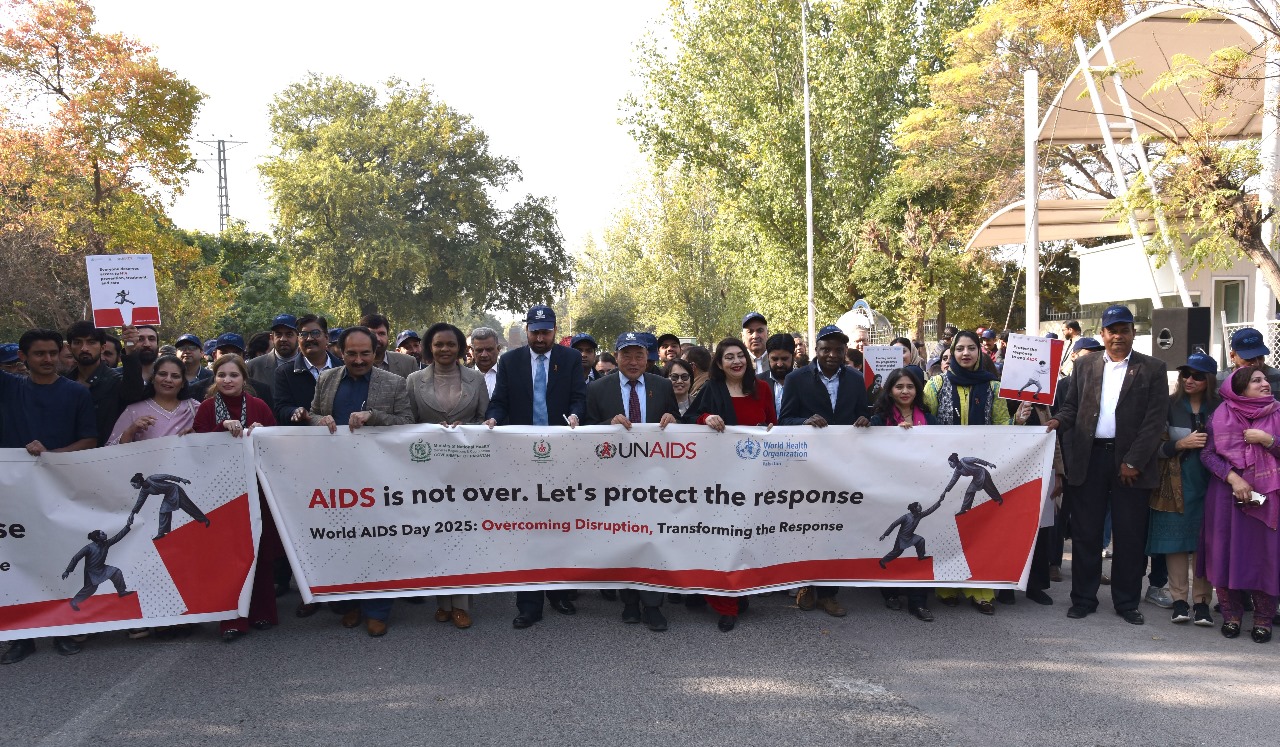
Under the theme “Overcoming disruption, transforming the AIDS response”, WHO and UNAIDS joined forces with Pakistan’s Ministry of Health to mark the date with an awareness walk calling for collective and individual action to intensify the HIV response and preventive measures. The main goal: to end the acquired immunodeficiency syndrome (AIDS) – which applies to the most advanced stages of HIV infection – as a public health threat by 2030.
“The discrimination, the stigma, and this disease cannot be curtailed only by us. It has to be the communities; it has to be the health regulatory authorities… We need everyone involved to end unsafe practices for injections and blood transfusions. We need to educate people. We need to take our clinicians on board as well. All of us, together, can achieve our goals. We need to give the children and the adults of Pakistan the healthy future they deserve, which is HIV-free,” said Pakistan’s Health Director General Dr Ayesha Majeed Isani.
It is estimated that 350,000 people are living with HIV in Pakistan, but almost 8 in 10 persons affected do not know their status. Children are increasingly affected, with new cases among those aged 0-14 years surging from 530 cases in 2010 to 1,800 in 2023.
Over the last decade, Pakistan has increased eightfold the number of persons living with HIV who receive antiretroviral therapy (ART) – from around 6,500 in 2013 to 55,500 in 2024 – thanks to joint efforts by the Government, UN entities, and partners. The country has also increased the number of antiretroviral therapy centres from 13 in 2010 to 95 in 2025.
Despite progress, in 2024, in Pakistan only an estimated 21% of people living with HIV knew their status, 16% of them were on treatment, and 7% had achieved viral load suppression. Over 1,100 AIDS-related deaths were reported in 2024.
“The surge in new cases and recent outbreaks that have particularly affected children – jeopardizing their future and Pakistan’s future – are a stark reminder of the urgent need to intensify joint efforts and mobilize both international and domestic resources to end the public threat of AIDS for good. WHO will stand with Pakistan and partners to protect the present and future generations from HIV, leaving no one behind,” said WHO Representative in Pakistan Dr Luo Dapeng.
“Together, we can still end AIDS as a public health threat by 2030, if we act with urgency, unity, and renewed commitment. Countries must make radical shifts to HIV programming and funding. The global HIV response cannot rely on domestic resources alone. The international community must renew its commitment to ending AIDS by 2030 and come together to bridge the financing gap to expand prevention, testing, treatment, and care, particularly for key populations, women and children”, said UNAIDS Director in Pakistan, Trouble Chikoko.
In Pakistan, children have been tragically exposed to HIV through unsafe injections and blood transfusions in recent outbreaks in Shaheed and Benazirabad, Hyderabad, Naushahro Feroze, and Pathan Colony (2025), Taunsa (2024), Mirpur Khas (2024), Jacobabad and Shikarpur (2023), and Larkana (2019). In several of these outbreaks, over 80% of detected cases involved children.
Only 14% of pregnant women in need of treatment receive it to prevent mother-to-child transmission of HIV, leaving thousands of children at risk. Among children aged 0–14 living with HIV, only 38% are on treatment.
WHO and UNAIDS stand with Pakistan and partners to end AIDS as a public health threat and build a healthier future for all.