News Desk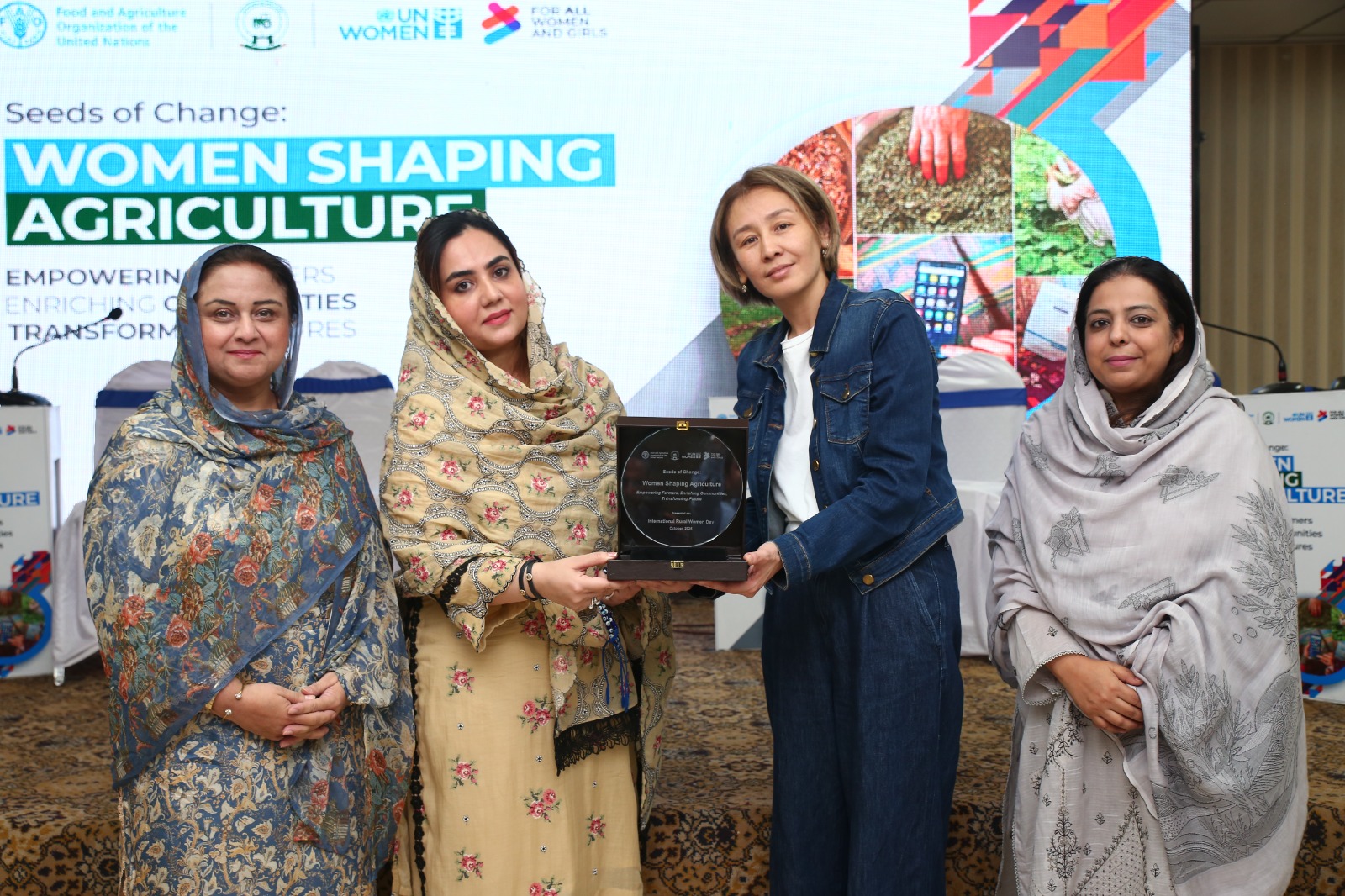
Spokesman Report
Peshawar, October 15, 2025 — To mark World Food Day and the International Day of Rural Women, UN Women, in collaboration with the Food and Agriculture Organization (FAO) and the Agriculture Department of Khyber Pakhtunkhwa (KP), hosted a provincial event titled “Seeds of Change: Women Shaping Agriculture in KP – Empowering Farmers, Enriching Communities, Transforming Futures.” The event, held at the Directorate General of Agriculture Research in Peshawar, aimed to celebrate and strengthen the role of women farmers in advancing sustainable agriculture, enhancing food security, and promoting gender equality in rural communities.
Speaking at the opening, Dr. Sumera Shams, Chairperson of the Khyber Pakhtunkhwa Commission on the Status of Women, reaffirmed the government’s commitment to inclusive development. “The Government of Khyber Pakhtunkhwa remains committed to supporting inclusive growth, where rural women have equal access to resources, decision-making, and opportunities. We are working closely with government institutions and civil society to ensure that women farmers in Khyber, Bajaur, Mohmand, and other merged areas are not left behind,” she said.
Zainab Qaiser Khan, Head of Sub-Office, UN Women Khyber Pakhtunkhwa, highlighted UN Women’s continued dedication to advancing gender equality in agriculture. “Today, we honor the resilience and strength of women farmers in the merged districts of Khyber Pakhtunkhwa, whose contributions are vital to food security and community well-being. UN Women stands committed to supporting their access to resources, training, and opportunities to ensure no woman farmer is left behind,” she noted.
Ms. Akmatbek Kiyal, Head of FAO–KP, emphasized the critical role of women in agriculture while acknowledging the challenges they continue to face, including limited access to resources, mobility restrictions, market exclusion, heavy workloads, and vulnerability to climate shocks. She noted that FAO’s targeted interventions aim to empower women through inclusive support and climate-resilient agricultural practices to improve livelihoods and ensure food security. She also reaffirmed that FAO’s initiatives are aligned with the principles of the Beijing Declaration and Platform for Action, underscoring the organization’s commitment to gender equality and women’s empowerment in rural development.
Two panel discussions focused on inclusion, innovation, and empowerment. The first explored gender-inclusive agricultural policies in Khyber Pakhtunkhwa, while the second featured women farmers from the merged districts sharing how UN Women and FAO’s initiatives on digital literacy, financial inclusion, and market access have transformed their livelihoods.
A vibrant exhibition of 15 stalls showcased agricultural produce and value-added products by women farmers from Khyber, Mohmand, and Bajaur, including dried fruits, vegetables, oils, and honey. The display highlighted interventions under the Livelihood and Food Security Support Activity, aimed at strengthening agricultural value chains through training and market linkages.
A key highlight of the event was the recognition of women farmers who successfully qualified for Akhuwat microfinance interest-free loans after completing financial literacy and business planning training under UN Women’s initiatives. These women were awarded cheques to expand their agricultural enterprises — a milestone achievement in advancing women’s financial inclusion in rural Khyber Pakhtunkhwa.
During the closing remarks, the Secretary for Agriculture, Government of Khyber Pakhtunkhwa, Dr Amber Ali Khan, reaffirmed the government’s commitment to strengthening women’s access to training, credit, and markets. “This initiative reflects our shared vision of an equitable and resilient agricultural future — one where women farmers are not just participants, but leaders,” he said.
Women farmers in the merged districts play a vital role in sustaining agriculture and supporting rural livelihoods. Empowering them with the necessary skills, tools, and resources is essential for improving productivity, ensuring food security, and strengthening local economies. Enhancing their capacities enables them to fully leverage their agricultural knowledge and contribute more effectively to community resilience and development.